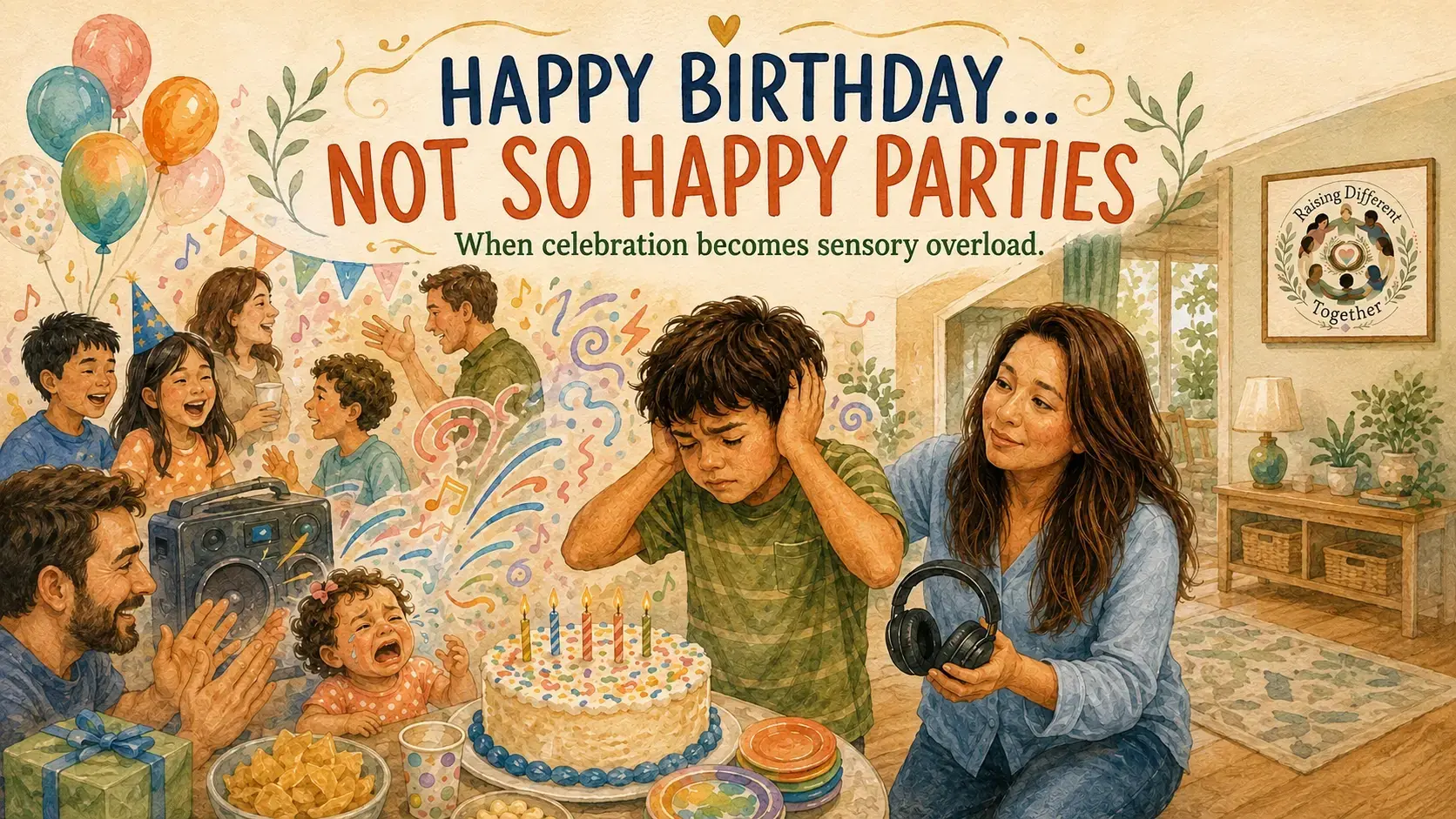
Happy Birthday… Not So Happy Parties
There is a very specific kind of overstimulation nightmare that a birthday party creates, and most people never clock it because to them it just looks like a party. Multiple conversations happening at once, crying, laughing, plates clattering, music playing, lights, smells, and then the transition into an entirely new setting on top of all of it.
Birthday parties can be incredibly hard for kids with sensory processing differences, not because of anything emotional about turning a year older, but because of sudden loud noises, harsh lighting, and surprise interactions that can trigger a meltdown in seconds. What looks like a celebration from the outside can look, from the inside of my sons’ nervous systems, like an assault on every sense at once.
When “Happy Birthday” Becomes Too Much
We have learned this the hard way, more than once. We now whisper happy birthday to Coah instead of singing it loudly, because the one time everyone sang at full volume, he ran from his own cake.
Carlos, when he was younger, almost knocked the candles clean off my birthday cake mid meltdown, and I remember the specific embarrassment of that moment, watching friends who had worked so hard to give me a nice one, try to hold the moment together anyway. Both boys tend to retreat into their own world at their own parties, barely socializing, because the room is simply too loud to process and connect at the same time.
Social Overload at Birthday Parties
Even the kids who do better socially pay for it afterward. Caydence genuinely loves people, she’ll work a room and enjoy every minute of it, and then she is completely depleted once it’s over, running on empty for the rest of the day. Coah will make his rounds, say hello to family and friends, and then need to disappear to somewhere quiet the moment he’s met that social quota, not because he doesn’t care, but because he’s used up what he had.
Parties we don’t host are their own separate challenge. Sometimes the boys opt out entirely. Sometimes they come and leave early with grandpa once it’s clearly too much. I’ve watched Coah stand at the edge of a group of kids, clearly wanting to play, with no real sense of how to enter that play or read the unspoken rules of it.
Carlos tends to gravitate toward the adults instead of kids his own age, not because he prefers adult company, but because small talk with peers is a skill that doesn’t come naturally to him, and adults are simply more predictable to navigate.
Why Some Party Venues Are Harder
Not every party is built to hold that. Our village, the people who know our kids and love them, will always make space without us even having to ask. But a birthday party at a bouncy house or trampoline park, with a handful of other parties happening at full volume in the same building, was never designed with sensory processing in mind, and it shows.
That is not a judgment on those spaces, it’s just the honest reality of what they are and are not built for. In fact, we once had to rent a whole bouncy slide for Coah with only a few friends in his godmother’s backyard. We brought the bouncy to him, and to this day it’s one of the best birthday parties he’s had.
How We Prepare for Sensory Overload at Parties
So, we do the work behind the scenes that nobody sees. We bring our own food when we can. We pack the comfy, familiar items that make an unfamiliar space feel survivable. We give transition warnings, verbal or visual, before asking them to move from one moment to the next.
We encourage them to tell us their triggers so we know exactly what to watch for, and we’ve taught them that they can’t control every environment, but they can lean on the tools we’ve given them, and on us, to get through it. If they can’t get out a full sentence about what’s wrong, “too much” is enough. That’s all we need to hear to start helping.
Have a story of your own? ❤
Every family’s journey looks different, whether you’re a parent, grandparent, aunt, uncle, or caregiver walking alongside a child with special needs. If you’d like to share your story with our community, we’d be honored to feature it. Reach out at hello@raisingdifferenttogether.com.
And if you’re in the thick of it right now, here’s how we help families like yours.
You’re not doing this alone.