Third Eye Kisses: The Highest Form of Love
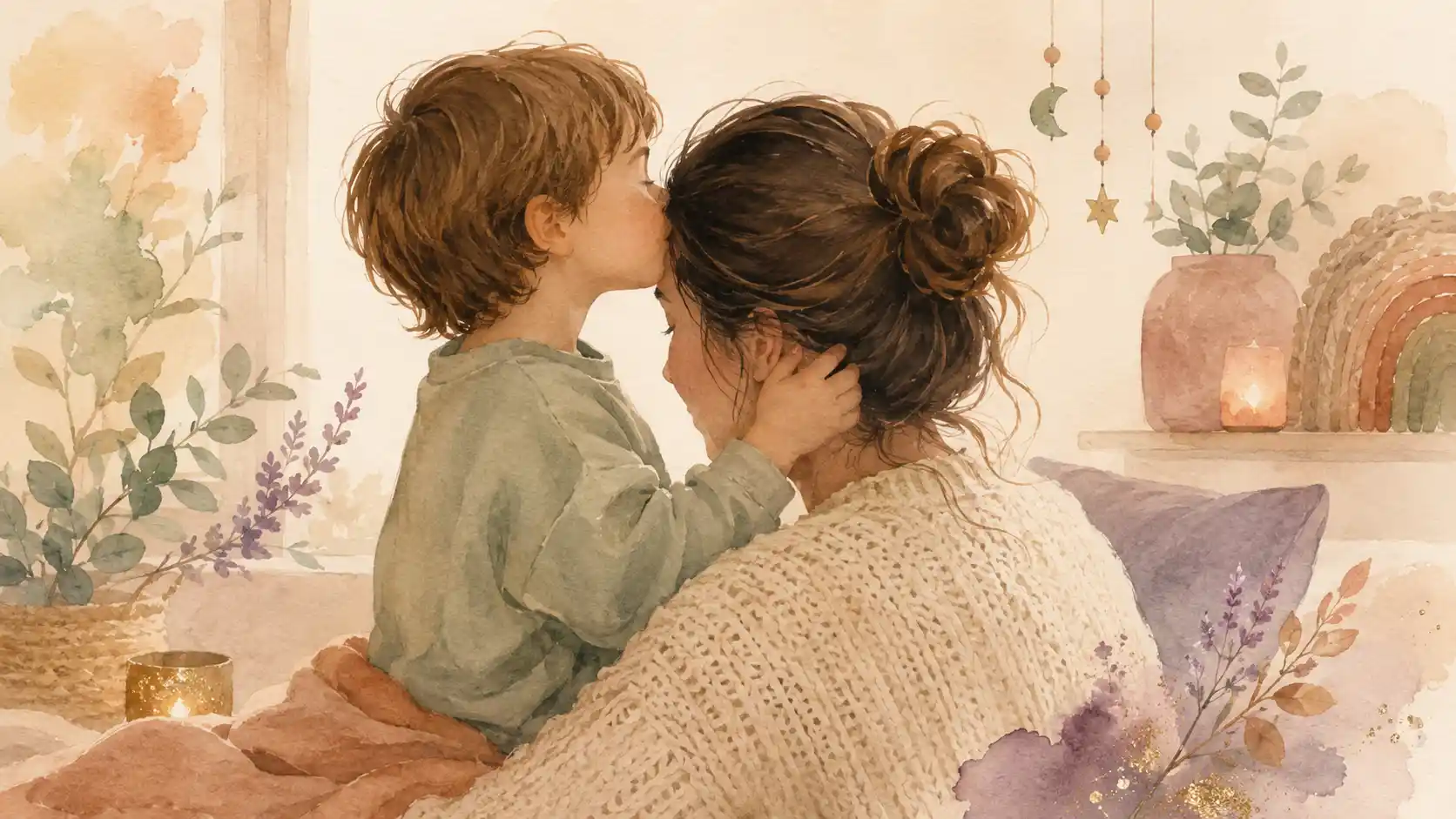
There is a kiss my kids give that isn’t on the cheek, isn’t on the lips, isn’t the kind you see in movies or greeting cards. It lands right between the eyebrows, on that quiet spot people call the third eye, and it is, without question, the highest form of affection I have ever received. It doesn’t happen on command. It doesn’t happen because I asked for it. It happens when it happens, and every single time, it stops me completely.
Love Does Not Always Look the Way the World Expects
Affection doesn’t always look the way the world expects it to. A hug can be too much input for a nervous system already working overtime. Saying “I love you” out loud can feel like a demand instead of an offering, words that don’t come easily even when the feeling behind them is enormous. So love finds another way out. It finds a forehead, a quiet press of lips right at the center, a gesture that asks for nothing back and simply says I see you, I trust you, I choose you, without needing a single word to carry it.
What makes it the highest form of love is exactly that it isn’t performed. Nobody taught them to do this because a book said it was sweet. It emerged on its own, from somewhere instinctive, somewhere that bypassed every social script and every expectation and just found the truest way to say what needed saying. When a child who finds most affection overwhelming chooses, on their own terms, to close that distance and press a kiss to the space between your eyes, you understand immediately that you are being given something rare. Not a habit. Not a routine. A choice, made freely, from a heart that doesn’t perform love, it simply gives it.
What a Third Eye Kiss Means
I don’t take a single one of these for granted. I know what it costs some of my kids to initiate touch at all, how much regulation and trust has to be in place before a body that finds so much of the world overstimulating decides that this, right here, is safe enough, wanted enough, worth reaching for. A third eye kiss is never small. It is a nervous system saying I am calm enough, right now, to give you this. It is a heart saying, in the only language that felt true enough, I love you completely.
Recognizing Your Child’s Language of Love
If your child has their own version of this, a gesture, a sound, a specific way they reach for you that isn’t quite like anyone else’s, I hope you recognize it for what it is. Our kids often express love in forms the world wasn’t necessarily built to notice, but that doesn’t make it quieter or smaller. If anything, it makes it louder, because it had to find its own way out, entirely on its own terms, and it found you anyway.
How My Children Show Love
Each of my kids has met me exactly where they are with this. Carlos is nineteen now, and to this day, a forehead kiss is still the only kiss he gives, unchanged since he was small, still just as full every single time. I will never forget the day he crossed the stage for his first college diploma. I was already in tears watching him walk across it, so much pride I could barely hold still, and then he came straight to me, diploma in hand, and gave me that same forehead kiss he’s given me his whole life. In that moment I remember thinking, I must have done something right in this life, or maybe the one before it, to have earned this kind of love. Caydence found her own language in hugs and every kind of kiss there is, affection given freely and often, in her own generous way. And Coah needs the squeezes and the full hug first, but then he presses his forehead to mine and exhales, long and slow, like something heavy just set itself down. All three of them find peace in it, and every single time, they hand that same peace right back to me.
Raising Different Together ❤
Have a story of your own? ❤
Every family’s journey looks different, whether you’re a parent, grandparent, aunt, uncle, or caregiver walking alongside a child with special needs. If you’d like to share your story with our community, we’d be honored to feature it. Reach out at hello@raisingdifferenttogether.com.
And if you’re in the thick of it right now, here’s how we help families like yours.
Does your child have their own unique way of showing love? Comment ❤ below, we’d love to hear about it, whenever you have the time and energy to share.
You’re not doing this alone.