
What “High-Functioning Autism” Can Actually Look Like
There is a version of autism people think they know. The child who does not speak. The child who needs obvious support all day. The child whose disability is visible enough that nobody has to argue about it.
And then there is the version that hides in plain sight.
The bright child. The verbal child. The gifted child. The one who makes eye contact sometimes, follows the rules, gets through the school day, and then falls apart at home. The girl with headaches and anxiety. The boy who can talk for an hour about trains but cannot start a writing assignment. The adult with degrees, a job, children, bills, and a lifetime of wondering why ordinary life seems to take so much more effort than it seems to take from everyone else.
The short answer: “High-functioning autism” is an informal term, not a diagnosis. It usually describes autistic people without an intellectual disability who speak and may do well academically. The label can hide real support needs, because a bright, verbal child can still struggle significantly with attention, sensory input, social demands, and daily functioning.
What Does “High-Functioning Autism” Mean?
This is the autism people often call “high-functioning.” I understand why people use that phrase. I’ve used it too. It’s usually meant to say: this person does not have an intellectual disability. They can speak. They can learn. They may be bright, gifted, funny, thoughtful, capable, and deeply loved.
But “high-functioning” can also be misleading, because people hear it and think “fine.” They hear it and think the needs must be small. They hear it and think the struggle cannot be that serious.
That’s the part I want to talk about. Because autism without intellectual impairment does not mean autism without disability. It often means the disability is harder for other people to see.
A note on language: “High-functioning autism” is not a current formal diagnosis. The clinical diagnosis is autism spectrum disorder. We use the phrase here because families still search for it and because this article explains why the label can hide very real support needs.
What Autism Looked Like in My Son
My son is autistic and ADHD. He scored in the 99th percentile on the NYC Gifted & Talented test when he was four years old. By the end of kindergarten, the school suggested he repeat the grade.
That is what autism and ADHD can look like in a bright boy. Not a child who “can’t learn.” A child who absolutely can learn, just not in the environment everyone kept insisting should work for him.
On paper, he often looked average. His cognitive scores were average. His verbal comprehension was strong. He had vocabulary. He had ideas. He could understand far more than he could always show in a classroom, and his math abilities were far beyond his age.
But underneath the word “average,” there were real disabilities. His sustained attention was tested and was in the extremely low range. His IEP goals went unmet year after year. He could sit through weeks of math instruction and come home unable to do a single review problem, then sit with his dad one-on-one for thirty minutes and score a 90 on the test the next day.
Thirty minutes. The ability was there. The access was not. That is one version of “high-functioning” autism: a child who looks capable enough that adults keep raising the expectations without changing the support.
It can look like a boy who loves trains, video games, animals, and building tracks. A boy who notices when his legally blind grandmother needs help, even though people may say he struggles with empathy. A boy who gets overwhelmed by noise, avoids tight clothes, needs sameness, hides his favorite things before guests come over, and cannot always read the invisible social rules everyone else seems to know.
It can look like a child who is “trying to be difficult.” But he is trying to survive a world that keeps treating his needs like preferences.
What Autism Can Look Like in Girls
This part is complicated, because my daughter does not currently have a formal autism diagnosis. I want to be very clear about that. She has ADHD, anxiety, a learning disability in math, auditory processing disorder, speech-language needs, and medical trauma from pediatric cancer that measurably changed how her brain processes information.
So I am not writing this to diagnose her in public. I am writing this because girls like her are exactly why so many families miss the signs.
In girls, autism or autistic traits can be quieter. Not easier. Quieter.
It may not look like the stereotype. It may look like anxiety. It may look like perfectionism. It may look like shutting down instead of melting down. It may look like headaches that happen at school but not at home. It may look like a child who cannot ask for the accommodation in the moment, so adults assume she doesn’t need it. It may look like a child who cries and goes nonverbal when questioned, while the adults around her misread the shutdown completely.
My daughter’s struggles were often explained away as stress, medical fatigue, anxiety, or “she’s doing fine.” But the paper told a different story, if anyone was willing to read it closely. Her math calculation fell to the 12th percentile while other parts of her thinking were much stronger. Her full-scale IQ dropped during cancer treatment, then partially recovered, but with lasting weaknesses in working memory and fluid reasoning. Her auditory processing testing showed that following directions was far harder for her than people realized.
And still, for too long, her supports in school were treated like a set of nice accommodations instead of a real plan.
This is why the “high-functioning” label can be so dangerous. When a child is bright, verbal, and pleasant enough, the system often waits for total collapse before it believes the struggle is real.
Girls are especially good at being misread. They may hold it together all day, then unravel in the car. They may copy the other kids just enough to pass socially, then come home exhausted. They may be described as dramatic, sensitive, anxious, shy, stubborn, oppositional, or “not applying herself.”
Sometimes they are not refusing. Sometimes they are overloaded. Sometimes their nervous system has been screaming all day, and the adults only hear it when the child finally cannot hold the mask anymore.
What Autism Can Look Like in Adults
I was diagnosed autistic and ADHD at 40. By then I had a bachelor’s and a master’s in accounting. I had worked as an auditor and an accounting manager. I was teaching college classes. I was married. I had children. I was the mom sitting in meetings, reading evaluations, organizing records, building timelines, and trying to understand why the school kept calling my kids “fine” when my gut knew they were not.
I became an advocate years before I understood that I was also describing myself. That is what autism without intellectual impairment can look like in an adult. It can look like competence. It can look like a woman who built systems around herself so carefully that nobody saw how much those systems were holding up.
But a medical crisis, or a failure in those systems, can throw everything off. In 2024, my husband had a medical incident that resulted in cognitive impairments. He has since recovered significantly, but I didn’t… not the way he did. What I couldn’t recover from was watching the scaffolding I’d built my whole life on get torn down in the blink of an eye.
At the time, I still didn’t have a diagnosis. As he recovered and life appeared to return to normal, I struggled to do even the most basic things. I would freeze when it was time to pay bills. I just couldn’t get back into the rhythm of it. I am an accountant. And I didn’t understand what was wrong, why I couldn’t do this seemingly simple thing. I would lose my words mid-conversation. I knew exactly what I wanted to say, and I couldn’t get the words out.
High-functioning autism in an adult can look like that. It can look like needing time to prepare for a phone call. It can look like struggling to make friends. It can look like doing the socially expected things because you know you’re supposed to, not because they come naturally. It can look like not being able to tolerate certain clothes and only realizing decades later that those were sensory issues, not character flaws. It can look like headaches in school that disappear when the environment changes.
It can look like being “fine” until life becomes too chaotic and all the invisible scaffolding collapses. That is what happened to me.
One Family, Three People, One Pattern
I did not go looking for my own diagnosis first. I went looking for my children’s. I read about ADHD because of my son. I read about autism because of my son. I read evaluations, checklists, reports, and descriptions that were supposed to explain him, and slowly I started seeing myself.
The tights I could not stand as a child were the tight clothes he could not stand now. The school-only headaches I had as a child came back through my daughter. The executive-function struggles I had built my entire life around were sitting in my children’s paperwork with clinical names.
One family. Three people. One pattern. Bright minds the systems called “fine.”
That is the part I want parents to understand. Autism without intellectual impairment does not always announce itself loudly. Sometimes it shows up as a gap. A gap between intelligence and output. Between what a child understands and what they can produce. Between how they look in school and how they fall apart at home. Between “average” scores and the amount of support it takes to reach them. Between what the world expects and what the nervous system can handle.
And when that gap is not understood, children get blamed for it. They are called lazy. Unmotivated. Too sensitive. Rigid. Defiant. Immature. Anxious. Fine.
Fine is the word that gets a lot of bright neurodivergent kids ignored. Fine because they are not failing badly enough. Fine because they are polite. Fine because they are gifted. Fine because they can talk. Fine because they held it together in the meeting. Fine because the report says average. But fine is not a diagnosis. And “high-functioning” is not the same thing as supported.
What to Look at Instead of a Functioning Label
If you are looking at your child and something does not add up, I want you to trust that feeling enough to look closer.
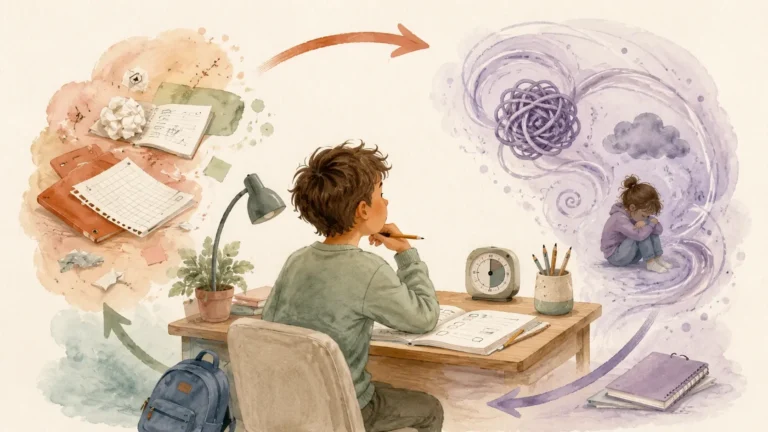
Look at the gaps, not just the overall score. Look at what happens after school, not just what the teacher sees during the day. Look at whether your child can do the work independently, consistently, and without emotional collapse, not whether they can do it once with a heroic amount of adult help. Look at sensory needs. Look at transitions. Look at rigidity. Look at shutdowns. Look at how much your child is masking. Look at whether the kid who seems “fine” at 10 a.m. is sobbing over homework at 6 p.m.
And if you are an adult reading this and thinking this sounds like me too, you are not broken because it took this long to name it. Many of us were bright enough to compensate, anxious enough to overprepare, and exhausted enough to assume everyone else was just handling life better.
A diagnosis did not make me autistic. I already was. It gave me language. It gave me context. And it made me a better advocate for my children, because I stopped asking, “Why can’t they just do it?” and started asking the better question: “What support would make this possible?”
That is the question schools should be asking too. Not whether a child is smart enough to be okay. Not whether they can sometimes perform. Not whether they look disabled enough to deserve help. The question is whether the environment, instruction, accommodations, and expectations match the child’s actual brain.
Because the right environment changes everything. I saw it with my son. In the right setting with smaller classes, calmer rooms, repetition, check-ins, teachers who understood him. He stopped looking like a child who could not learn and started looking like who he had been all along: bright, curious, capable, and finally able to access what was being taught. In the right setting in 5th grade, he told me “I feel like I am learning in school for the first time”.
That is not a miracle. That is support. That is access. And support should not require a child to collapse first.
So yes, autism can look like the child people already picture. But it can also look like my son. It can look like my daughter’s quiet shutdowns and school-only symptoms, even as we keep asking the diagnostic questions carefully and responsibly. It can look like me; a 40-year-old mother with degrees and a career, sitting in my children’s paperwork and finally finding my own name there.
High-functioning was never the whole story. The whole story is this: a person can be bright and disabled. A child can be gifted and drowning. A girl can be quiet and overwhelmed. An adult can be successful and struggling.
And “fine” can be the most dangerous word in the room when everyone stops looking after they say it.
Common Questions
Is high-functioning autism the same as Asperger’s?
Asperger’s syndrome was a separate diagnosis until 2013, when it was folded into autism spectrum disorder. Many people who once would have been diagnosed with Asperger’s are now diagnosed with autism spectrum disorder.
Can a child with “high-functioning” autism get an IEP?
Yes. Autism is one of IDEA’s disability categories, and eligibility depends on how it affects the child’s education, not on IQ.
Keep Reading: Understanding Your Neurodivergent Child
- The Safe Food Struggle: Sensory Processing and Safe Foods
- Happy Birthday… Not So Happy Parties: Sensory Overload
- The Rules Aren’t Rules. They’re a Map.
- Vacationing with Special Needs Kids
- Play It Again: Why Neurodivergent Kids Rewatch Movies
- Moving Their Minds: Sports and Movement for Neurodivergent Kids
- Third Eye Kisses: How Neurodivergent Kids Show Love
- Smiles, Tears, and the Medication Question
- The Catch-22 of ADHD and Anxiety
- Child OCD Diagnosis: When Anxiety Stacks on ADHD
This is educational information from a parent advocate and late-diagnosed autistic + ADHD adult, not medical or legal advice. If you suspect autism, ADHD, a learning disability, or another disability, consider a comprehensive evaluation from a qualified clinician, and put school concerns in writing.
Raising Different Together ❤
Has your child ever been called “fine” because they were bright, verbal, or holding it together at school? Comment ❤ below. What were other people missing?
Have a story of your own? ❤
Every family’s journey looks different, whether you’re a parent, grandparent, aunt, uncle, or caregiver walking alongside a child with special needs. If you’d like to share your story with our community, we’d be honored to feature it. Reach out at hello@raisingdifferenttogether.com.
And if you’re in the thick of it right now, here’s how we help families like yours.
You’re not doing this alone.