“You’re So Brave” and Other Things Strangers Say
There is a very specific exhaustion that comes from being a special needs parent in public, and it has nothing to do with your actual child. It’s the running commentary from strangers, and sometimes family, who mean well, or think they do, and hand you their unsolicited opinion anyway. Some of it is sweet and clumsy. Some of it is genuinely harmful. All of it adds up to a kind of tax you pay just for existing in the world with your kids.
The short answer: Avoid comments that question the diagnosis (“he doesn’t look autistic”), treat it as a tragedy (“I’m so sorry”), or offer unsolicited advice. What helps most is trusting that parents know their children and asking, “How can I support you?”
When Disability Is Expected to Look a Certain Way
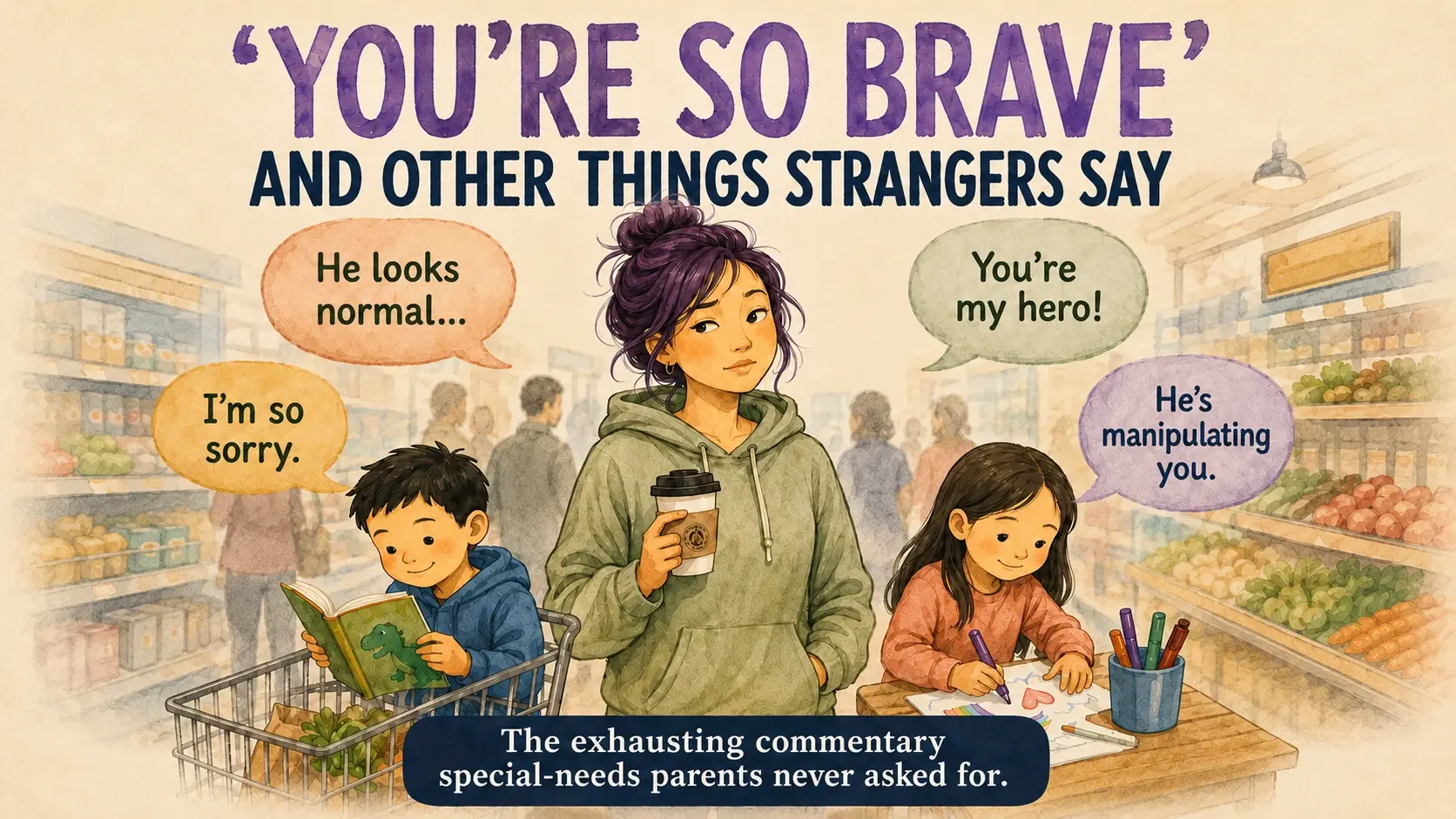
“He looks normal to me. He doesn’t look like he has autism.” I hear this about both Carlos and Coah, usually delivered like a compliment, like I should be relieved my son doesn’t wear his diagnosis on his face. Autism doesn’t have a look. Cerebral palsy doesn’t always announce itself either. What that comment actually reveals is an expectation that disability should be visible to be believed, and when it isn’t, the diagnosis itself gets quietly questioned, as if I made an appointment with a neurologist for fun.
And then there’s the flip side of that same coin: “I’m so sorry.” I share a diagnosis, plainly, factually, the way I’d mention anyone’s name or age, and I get met with condolences like I just announced a death. What, exactly, are you sorry for? My children are not tragedies. Their diagnoses are not something that happened to me that requires sympathy. That reaction says far more about the assumptions someone is carrying into the conversation than it does about my actual family, and it’s one of the responses I have the least patience for, because there is genuinely nothing to be sorry about.
“Caydence is doing fine. If you didn’t say anything, I wouldn’t have known.” This one stings in a different way, because it’s true, and that’s exactly the problem. She wasn’t diagnosed until this year because she masked well enough that even I had to fight to be believed for three straight years. When someone says this to me now, what I actually hear is a preview of every teacher and doctor who dismissed her for the very same reason. Her doing “fine” in public is not evidence there’s nothing there. It’s evidence of how much work she’s doing to make it look that way.
Why “You’re So Brave” Can Feel So Lonely
“How do you do it? I could never. You’re my hero.” I know this one comes from a genuinely kind place, and I don’t want to be ungracious about it. But it sits strangely on me every time, because I don’t always feel heroic. Some days I feel like I’m barely keeping my head above water, second-guessing every decision, wondering if I’m doing enough, if I’m the right kind of enough, for three kids who each need something different from me at the same time. Being told you’re a hero when you’re privately unsure you’re even doing okay is its own quiet kind of lonely.
When Unsolicited Advice Becomes Harmful
Then there’s the advice that crosses all the way into harmful. “He’s manipulating you. You shouldn’t give in. Starve him, he’ll eat when he’s hungry.” No. It’s sensory. It is not a battle of wills over a chicken nugget, it is a nervous system that registers certain textures and flavors as genuinely intolerable, and “just wait him out” is not a parenting hack, it’s a good way to escalate a meltdown while teaching him that his own body’s signals don’t matter. This kind of advice almost always comes from people who’ve never had to sit across from a child whose food refusal isn’t stubbornness, it’s neurology.
Most of this, the well-meaning and the harmful alike, comes from people without special needs kids of their own, people working entirely off of a general parenting playbook that simply doesn’t apply here. I understand the instinct. Advice-giving often comes from wanting to help, or wanting to relate, or sometimes just wanting to fill an uncomfortable silence. But secondhand certainty about a child you’ve known for five minutes is not the same as lived expertise, and the gap between those two things is exhausting to keep re-explaining, over and over, to a new person every single week.
What to Say Instead to a Special Needs Parent
What I actually want from people, more than advice, more than being called brave, is simpler than either. I want people to trust that I know my own children better than a stranger’s first impression does. I want the benefit of the doubt extended to the parent who’s been in the trenches, not the passerby who caught thirty seconds of it. And if you don’t know what to say, “how can I support you” goes a lot further than “you’re so brave.”
Raising Different Together ❤
Have a story of your own? ❤
Every family’s journey looks different, whether you’re a parent, grandparent, aunt, uncle, or caregiver walking alongside a child with special needs. If you’d like to share your story with our community, we’d be honored to feature it. Reach out at hello@raisingdifferenttogether.com.
And if you’re in the thick of it right now, here’s how we help families like yours.
What’s the comment you’ve heard the most, sweet or otherwise? Comment ❤ below, we’ve probably heard it too.
You’re not doing this alone.