How to Build Your Special Education Advocacy Binder
By the time you’ve requested an evaluation and started documenting everything in writing, you’re going to have paper. Lots of it. Evaluations, emails, IEP drafts, report cards, therapy notes, correspondence with the district. Without a system, all of that lives scattered across your inbox, a kitchen drawer, and your own memory, which is exactly where critical details go to disappear right when you need them most. Your advocacy binder is the tool that fixes this. It’s not just a folder of papers. It’s your evidence, your memory, and your peace of mind, all in one place, ready when you need to advocate for your child.
The short answer: A special education advocacy binder holds your child’s evaluations, every IEP or 504 plan, report cards and progress reports, medical records, and a dated log of every school communication. Organize it by category and in date order, with an index at the front.
What Should Be in a Special Education Advocacy Binder?
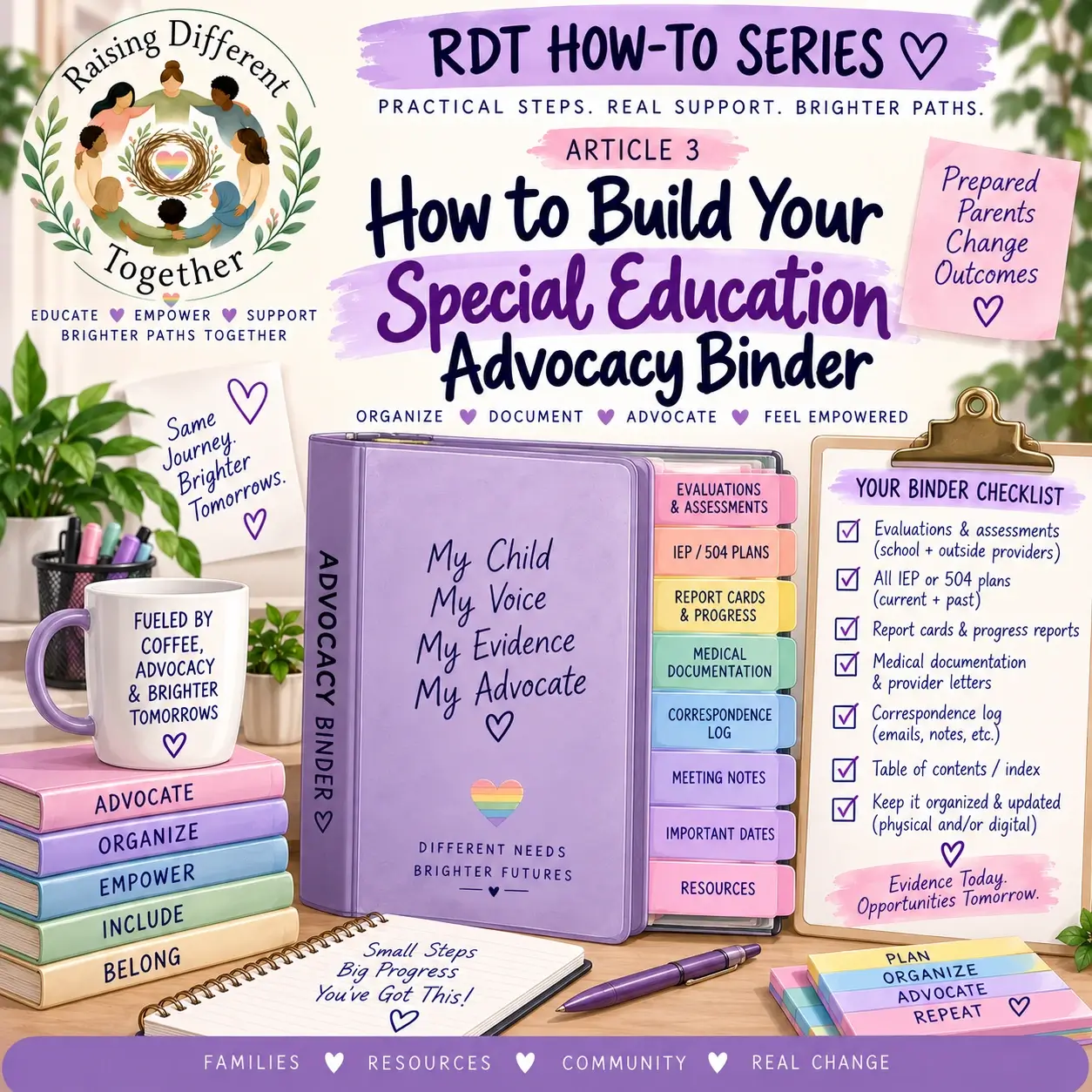
Start with the big picture: your binder needs to hold every category of documentation that tells the story of your child’s educational journey. That means evaluations and assessments, both from the school and from any outside providers you’ve used. It means every IEP or 504 plan your child has ever had, including old versions, because tracking what changed over time is often where the real evidence lives. It means report cards and progress reports, because academic performance data supports or contradicts what the district claims is happening. It means medical documentation, diagnoses, letters from doctors or therapists that speak to your child’s needs. And it means your correspondence log, every email, every meeting note, everything we talked about building in how to write an effective email to your school district. These aren’t optional categories. Each one plays a specific role when you’re building a case for what your child needs.
Should Your Advocacy Binder Be Physical or Digital?
Whether you go physical or digital depends on how you work best, but I’d encourage you to consider both. A physical binder is invaluable in meetings, when you need to pull a document immediately without fumbling through a phone or laptop while people are staring at you across a conference table. But a digital backup protects you from the physical binder getting lost, damaged, or simply becoming too bulky to manage as your child’s file grows year over year. Whatever you choose, the principle that matters most is this: everything needs to be organized in a way that lets you find a specific document in under thirty seconds, because during a tense meeting or a time-sensitive deadline, thirty seconds can feel like an eternity if you’re digging through unsorted papers.
How to Organize Your Special Education Binder
Chronology matters as much as category. Within each section, keep documents in date order, and consider creating a simple index or table of contents at the front, so you or anyone helping you can navigate quickly. This becomes especially important if your case ever escalates to mediation or due process, or if a disputed timeline comes up during a CSE meeting, where having a clear, organized timeline of every evaluation, every request, every response, and every gap in services can make or break your ability to demonstrate what actually happened. I won’t walk through the exact tabbing system or internal structure I use with my own clients here, because building that system, tailored to your child’s specific situation, is genuinely part of what we do at Raising Different Together. But I want you to know the core categories and the organizing principle, because even a basic version of this binder puts you leagues ahead of where most parents start.
If building this system while managing evaluations, emails, appointments, and everything else on your plate feels like one more thing you don’t have the bandwidth for, that’s incredibly common, and it’s exactly the kind of support we provide. We build customized advocacy binders for families who need the structure without the added labor of creating it themselves during an already overwhelming season. Sometimes the most strategic thing you can do for your child is outsource the organizing so you can spend your limited energy on the fight itself.
Special Education Advocacy Binder Checklist
Here’s a quick recap of what your binder needs to include, however you choose to build it:
- Evaluations and assessments, from the school and any outside providers.
- Every version of your child’s IEP or 504 plan, current and past.
- Report cards and progress reports.
- Medical documentation, diagnoses, and provider letters.
- Your correspondence log, organized and dated.
- A simple index or table of contents so anything can be found quickly.
With your binder built and your documentation organized, you’re ready for one of the most important moments in this entire process: the IEP meeting itself. That’s where all of this preparation gets put to use, and knowing how to walk into that room prepared changes everything. We’ll cover exactly how to prepare for that meeting next.
Common Questions
Can I get copies of my child’s school records?
Yes. Parents have the right to inspect and review their child’s education records. Under IDEA, the school must respond without unnecessary delay, before any IEP meeting, and within 45 days at most.
Should my advocacy binder be physical or digital?
Ideally both, because they do different jobs. Your digital binder is the complete record: every email, report, and document, dated and searchable. Your physical binder is what you bring into meetings, with the key documents you may need to pull quickly, not every email printed out. Either way, you should be able to find any document in under thirty seconds.
How should I organize the documents in my binder?
Sort them by category, then keep each section in date order. Add a simple index or table of contents at the front so you, or anyone helping you, can find things quickly.
Why should I keep old IEPs and 504 plans?
Tracking what changed from one plan to the next is often where the real evidence lives. Older versions show what was promised, what was removed, and how your child’s supports shifted over time.
The Conversation Continues
If you’d rather have us build your advocacy binder for you, customized to your child’s specific documentation and needs, we’re here for that. You don’t have to build this system alone while everything else is happening at once.
Send us an email or book a free 20-minute phone call to learn more about our advocacy binder service. Reach us at hello@raisingdifferenttogether.com.
Whether you build it yourself or let us build it for you, this binder is about to become one of the most powerful tools in your advocacy toolkit.
Keep Reading: Records and School Emails
- I Just Want to Confirm My Understanding: The Follow-Up Email After a School Meeting
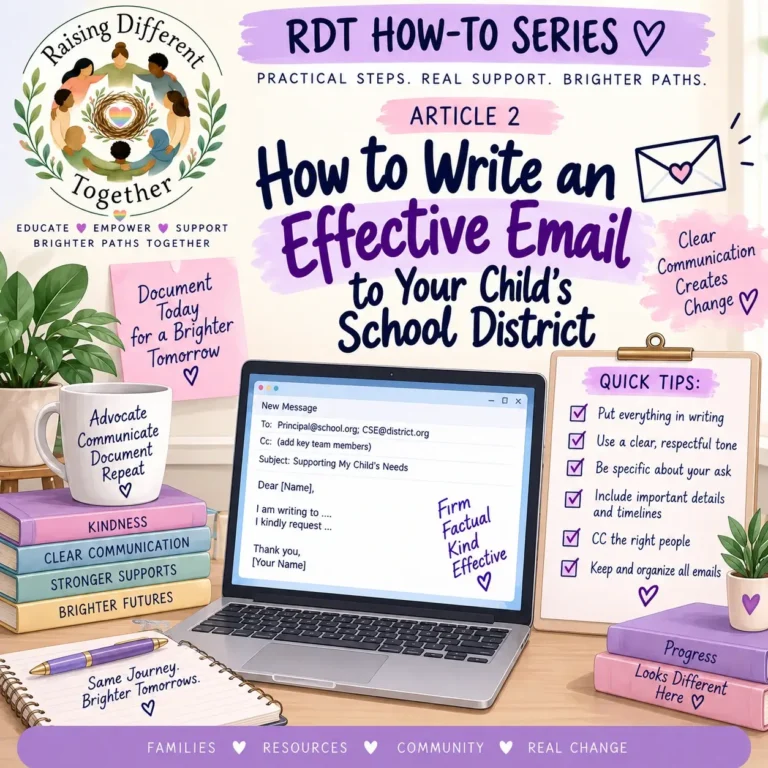
- How to Write an Effective Email to Your Child’s School District
You don’t have to do this alone.
Feeling buried in paperwork? We help parents organize the record, understand what’s actually in front of them, and prepare for the next conversation, so you walk in focused instead of overwhelmed.
You’re not doing this alone.