The Catch-22 of ADHD and Anxiety
ADHD and anxiety show up together far more often than most people realize, and once you understand why, it stops looking like a coincidence and starts looking like a trap. Research puts the overlap somewhere between 25 and 50% of people with ADHD also meeting criteria for an anxiety disorder, with some studies of adults finding rates as high as 47 to 56%. This isn’t two unrelated diagnoses that happen to land in the same kid. It’s two systems that feed each other, and that’s exactly what makes it so hard to untangle, and so hard to treat as two separate problems.
The short answer: ADHD and anxiety often occur together. ADHD’s struggles with organization and follow-through create real setbacks that feed anxiety, and anxiety uses up the attention ADHD already struggles to direct. Because each can look like the other, an evaluation should look at both.
How ADHD and Anxiety Can Reinforce Each Other
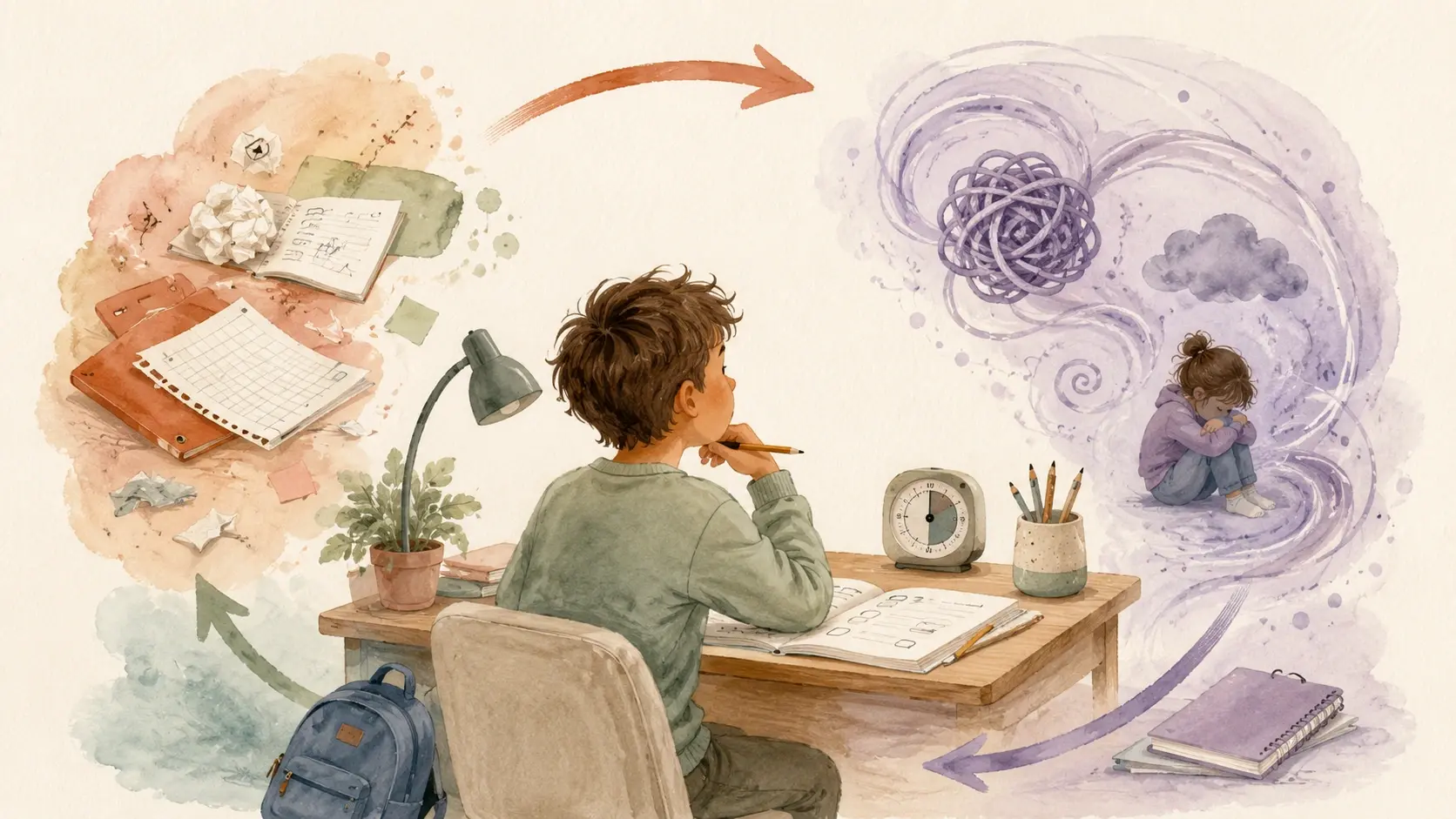
Here’s the catch-22 at the center of it. ADHD makes organization, time management, and follow-through genuinely difficult, not from a lack of trying, but from how the brain is wired to handle executive function. That difficulty creates a steady stream of real consequences, missed steps, forgotten instructions, tasks started with good intentions and abandoned halfway. Living inside that pattern, over and over, is exhausting and demoralizing, and it becomes fertile ground for anxiety to take root. So the ADHD can contribute to the anxiety. But then the anxiety turns around and makes the ADHD symptoms worse, worry and racing thoughts eating up the same limited attention an ADHD brain already struggles to direct. Each condition hands the other one more fuel, and you’re left trying to figure out where one problem ends and the other begins.
Three Kids, Three Different Presentations
This plays out differently in each of my three kids, which has taught me the loop doesn’t have just one shape.
Coah: When Anxiety Becomes School Avoidance
For Coah, it shows up as school avoidance. His anxiety and his ADHD tangle together until the idea of walking into that building becomes physically unbearable, not because he doesn’t want to learn, but because his nervous system has learned to associate that specific environment with overwhelm. It shows up in his body before it ever shows up in words, crying that comes on fast and hard, throwing up on the mornings the dread gets to be too much, and avoidance becomes the only thing that feels like relief in the moment, even though it feeds the anxiety right back.
Carlos: Anxiety About Public Safety
For Carlos, the anxiety takes a different shape entirely, rooted in public safety. Because his cerebral palsy makes him move slower than the people around him, he carries real, founded worry about navigating public spaces, crossing a street in time, keeping pace in a crowd, being caught somewhere he can’t get out of quickly if something goes wrong. In the moments that worry peaks, he freezes, entirely still, like a deer caught in headlights, his body choosing stillness when his legs can’t reliably choose speed. That is not irrational anxiety. It’s his nervous system accurately tracking a real physical vulnerability, and that constant vigilance pulls on the same attention and regulation systems his ADHD already asks so much of, which makes it harder for him to focus on anything else while he’s out in the world.
Caydence: Test Anxiety and Executive Function
For Caydence, it shows up as test anxiety, and it traces directly back to executive function. Difficulty focusing and difficulty getting started are hallmark ADHD struggles, and when you put her in front of a timed test, that combination becomes its own kind of countdown to panic. Her body tells on her every time, headaches that show up right as the test begins, a choking feeling in her throat, hands so clammy she has to keep wiping them on her jeans before she can hold the pencil steady. The harder it is to start, the less time she has left to finish, and the less time she has left, the harder it becomes to focus at all. By the time she’s actually writing, she’s fighting the anxiety as much as she’s fighting the material itself.
Why Evaluations Need to Look at Both
Three kids, three completely different presentations, and the same underlying loop running underneath all of it. This is exactly why an evaluation that only screens for ADHD, or only screens for anxiety, can miss the fuller picture entirely. A child who looks inattentive might be distracted by worry. A child who looks anxious might be anxious about the very real consequences of ADHD symptoms nobody has named yet. Treatment has to reflect that overlap, therapy alongside medication management where appropriate, because addressing only one half of the loop tends to leave the other half fully intact, waiting to pull the whole cycle right back into motion.
If you’re watching your own child cycle through this, task avoided, anxiety spikes, focus gets harder, task avoided again, you are not imagining the pattern. It is a documented, well-researched loop, and naming it accurately, for your specific child’s specific version of it, is the first real step toward breaking it. Push your evaluators to look at both conditions together, not in isolation, and don’t accept a plan that only treats whichever symptom happens to be loudest in the room that day.
Common Questions
How can I tell if it’s ADHD or anxiety?
Often you can’t tell from the outside. A child who looks inattentive may be distracted by worry, and a child who looks anxious may be reacting to ADHD struggles. A comprehensive evaluation that looks at both is the best way to sort it out.
Can a child with ADHD and anxiety get support at school?
Yes. Depending on how it affects learning, a child may qualify for a 504 plan or an IEP. ADHD is often covered under IDEA’s “Other Health Impairment” category. Start by requesting an evaluation in writing.
This article shares one family’s experience and general educational information, not medical advice. ADHD and anxiety require individualized evaluation and treatment by qualified healthcare professionals. Do not start, stop, or change medication without consulting your child’s clinician.
Raising Different Together ❤️
Does this catch-22 show up in your house too, and what does it look like for your kid? Comment ❤️ below, we’re always learning from each other here.
Have a story of your own? ❤
Every family’s journey looks different, whether you’re a parent, grandparent, aunt, uncle, or caregiver walking alongside a child with special needs. If you’d like to share your story with our community, we’d be honored to feature it. Reach out at hello@raisingdifferenttogether.com.
And if you’re in the thick of it right now, here’s how we help families like yours.
You’re not doing this alone.