How to Request a Special Education Evaluation for Your Child
Somewhere along the way, you started noticing things. Maybe it was your child’s teacher mentioning a concern at pickup. Maybe it was your own gut telling you something wasn’t adding up, the meltdowns after school, the way homework turned into an hour-long battle, the way your child seemed to be working twice as hard as their peers just to keep up. Whatever brought you here, you’ve landed on the same starting point every parent in this world eventually reaches: it’s time to request an evaluation. And if you’ve never done this before, I want you to know that the process is more accessible than it feels right now. You don’t need a lawyer. You don’t need special training. You need to know your rights, put your request in writing, and understand what happens next.
The short answer: Send a dated written request, by letter or email, to your child’s principal and your district’s Committee on Special Education (CSE), asking for an initial evaluation under IDEA. Include your child’s name, date of birth, grade, school, and a few sentences about your concerns. Keep a copy. In New York, the district generally must ask for your consent within 10 days, and the evaluation generally must be finished within 60 calendar days after you consent.
When Can You Request a Special Education Evaluation?
Here’s the first thing I want you to internalize: you have the right to request an evaluation when you believe your child may have a disability and may need special education and related services. You don’t need a doctor’s referral. You don’t need the school to suggest it first, though sometimes they do. Under IDEA, the Individuals with Disabilities Education Act, parents have the legal right to request that their child’s school district evaluate them for special education services. This applies whether your child is struggling academically, socially, emotionally, behaviorally, or all of the above. If you suspect your child may have a disability that’s impacting their ability to access their education, that’s enough. You don’t need to prove anything yet. That’s what the evaluation is for.
How to Request a Special Education Evaluation in Writing
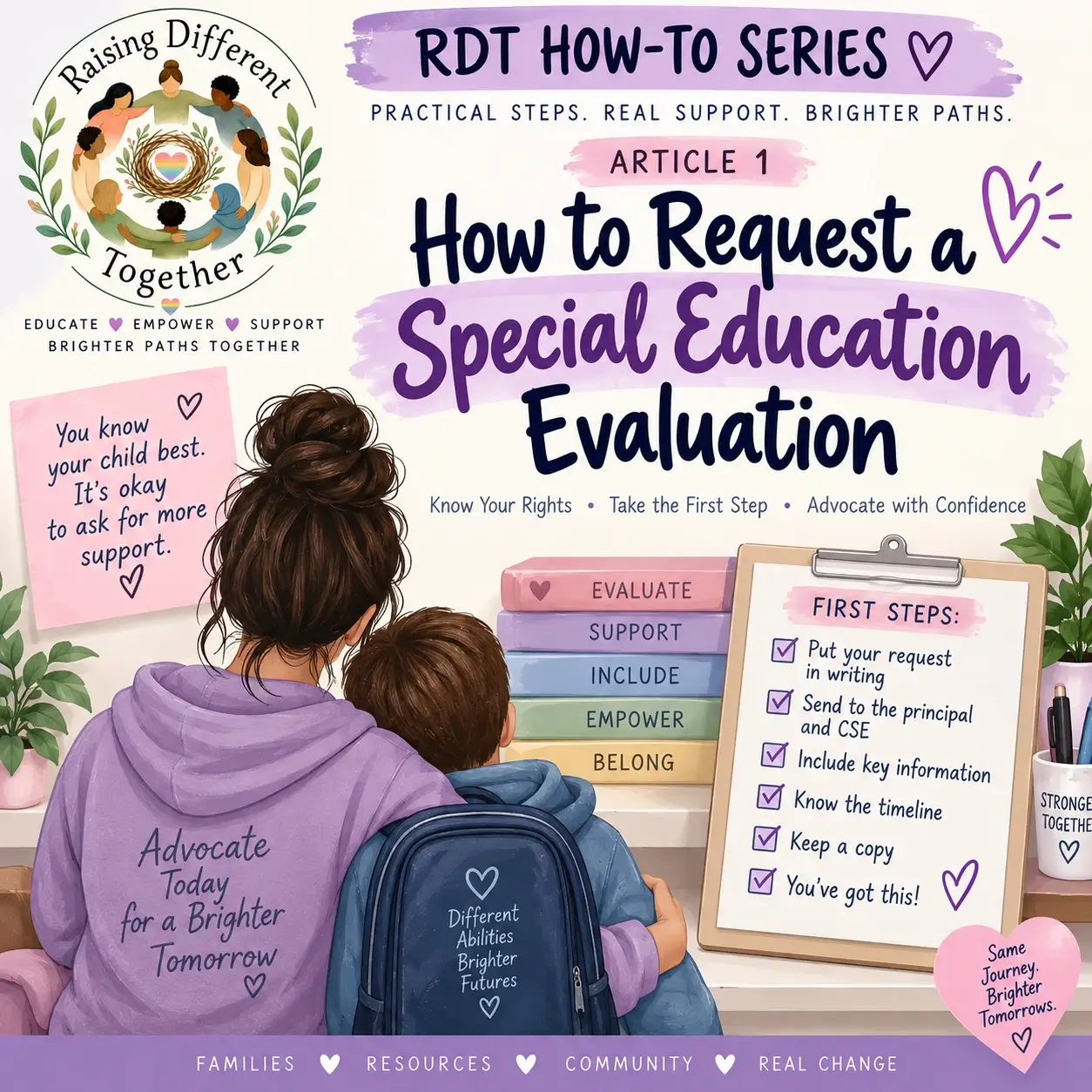
The request itself needs to be in writing. This is non-negotiable, and I say that as someone who learned the hard way that verbal conversations disappear the moment they end. Write a letter or an email to your child’s school principal and the district’s Committee on Special Education, or CSE, formally requesting an evaluation. State clearly that you are requesting an initial evaluation to determine your child’s eligibility for special education services under IDEA. Include your child’s name, date of birth, current grade, and school. Briefly describe your concerns, but you don’t need to write a novel here. A few sentences about what you’re observing is enough: academic struggles, behavioral concerns, developmental delays, whatever brought you to this point. Date the letter. Keep a copy for yourself, this is the very first document that will go into your advocacy binder, the foundation of everything else you’ll build from here. This document is now the official start of your paper trail, and that paper trail matters more than you know right now.
What Happens After You Request an Evaluation?
Once your written request is submitted, the district has a legal timeline they must follow. They are required to respond to your request, and if they agree to evaluate, they must obtain your written consent before testing begins. In New York, once the district receives your written consent, the initial evaluation generally must be completed within 60 calendar days. Other parts of the process have separate timelines, and other states may use different rules. There is a clock, and the district doesn’t get to sit on your request indefinitely. If you don’t hear back, follow up in writing. IDEA does not set one nationwide deadline for responding to a parent’s initial request, and state rules vary. In New York, the district generally must request your consent to evaluate within 10 days after receiving the referral. Politely, but firmly, use the same clear and factual communication style that’s going to serve you throughout this entire process. You are not being difficult. You are exercising your right to timely communication about your own child.
What If the School Refuses to Evaluate Your Child?
If the district refuses to evaluate, they must provide you with something called Prior Written Notice, explaining exactly why they’re denying your request and what data they used to make that decision. This is important, because a refusal is not the end of the road. You have the right to challenge that decision, and there are formal processes for doing so, including requesting mediation or filing for due process. But most of the time, if your request is clear, timely, and grounded in genuine concern, the district will move forward with the evaluation. And once that evaluation is complete, the results become the evidence you’ll bring into the IEP meeting and, eventually, into any CSE meeting where eligibility and placement get decided. Trust that the system, imperfect as it is, is built to respond to a parent who knows their rights and puts them in writing.
Special Education Evaluation Request Checklist
Before you move forward, here’s a quick recap to keep this process on track:
- Put your evaluation request in writing. Email or formal letter, either works, but it needs to be documented.
- Send it to both the school principal and the district’s Committee on Special Education (CSE).
- Include your child’s name, date of birth, grade, school, and a brief description of your concerns.
- Keep a copy of everything you send. Date it. File it.
- Know your state’s timeline for evaluation completion, and follow up in writing if you don’t hear back.
- If denied, request Prior Written Notice explaining why, and know that you have the right to challenge that decision.
This is where the fight begins, but it’s also where your voice starts to matter in a very real, very legal way. Once you’ve sent that written request, the next step is knowing how to communicate effectively with the district throughout this entire process, because how you write to them matters just as much as what you’re asking for. We’ll walk through that next.
Common Questions About Requesting an Evaluation
Do I need a doctor’s diagnosis?
No. You can request an evaluation based on your concerns alone.
Does it cost anything?
No. The school district’s evaluation is free for families.
What if my child attends a private or religious school in NYC?
Send the request to the CSE for your district.
Official sources and further reading
Federal guidance and local procedures can differ. These official resources provide more detail on the processes discussed above.
The Conversation Continues
If your child’s records are already starting to pile up, we can help you organize the history, identify what matters, and prepare a clear advocacy binder for the next step. See our Advocacy Binder Prep options, book a free 20-minute call, or email us at hello@raisingdifferenttogether.com.
You already did the hardest part. You noticed. Now let’s get your child what they need.
You don’t have to do this alone.
Feeling buried in paperwork? We help parents organize the record, understand what’s actually in front of them, and prepare for the next conversation, so you walk in focused instead of overwhelmed.
You’re not doing this alone.