Understanding 504 Plans: Their History, Process, and Real Limits
A 504 plan can be exactly the right fit for one child and completely insufficient for another, and understanding why starts with understanding what it actually is. Section 504 of the Rehabilitation Act of 1973 was the first civil rights law in the United States to prohibit discrimination against people with disabilities in any program receiving federal funding, and that includes public schools. In schools, Section 504 requires equal access and a free appropriate public education. Depending on a student’s individual needs, that may include accommodations, regular or special education, and related aids and services.
A 504 plan may not be enough when accommodations alone aren’t meeting your child’s needs, when the plan isn’t being consistently implemented, or when your child needs specially designed instruction. In those situations, it may be worth asking whether an evaluation for special education eligibility under IDEA is appropriate.
How Section 504 Became a Civil Rights Protection
The history is short but worth knowing. President Nixon signed Section 504 into law in 1973, as part of the Rehabilitation Act, and it sat almost entirely unenforced for years until disabled activists forced the issue, staging sit-ins across the country in 1977, including a 26 day occupation in San Francisco, the longest occupation of a federal building at that time. That pressure is the reason 504 has real enforcement teeth today. It’s a civil rights law, not a favor, and it exists in its usable form because people fought for it.
When Is a 504 Plan Enough?
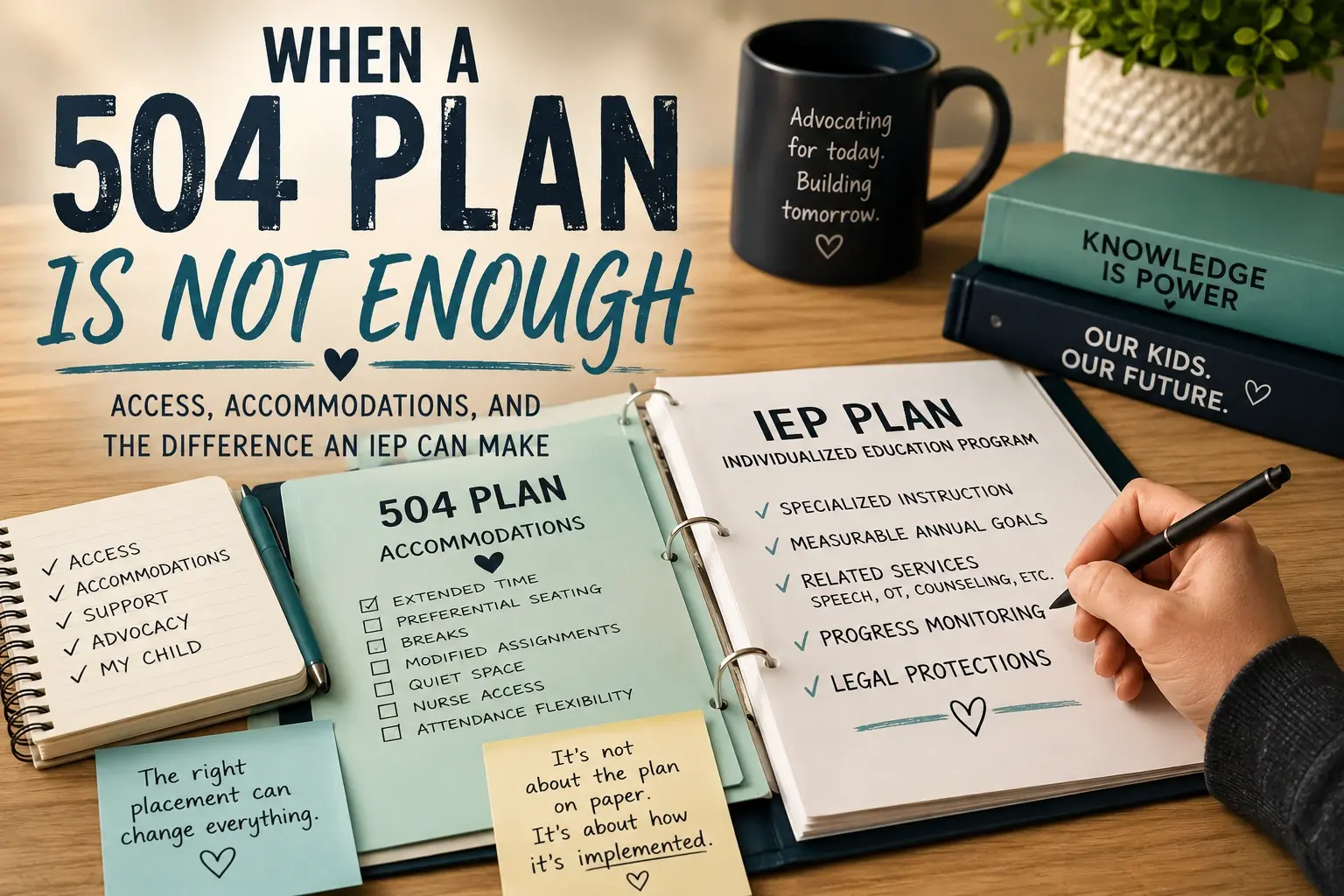
Here’s where it helps some kids and falls short for others. Many 504 plans are built around accommodations, changes to how a student accesses their existing curriculum. Things like extended time, preferential seating, breaks built into the day, modified assignments, access to a nurse or a quiet space, and adjusted attendance policies for a chronic health condition. But federal law does not limit Section 504 to accommodations alone. Depending on the child’s needs, the plan may also include special education or related aids and services.
For a child whose disability doesn’t require specialized instruction, just a fairer playing field to access the same material as everyone else, a 504 can genuinely be enough. A 504 plan does not use the same required IEP structure, including measurable annual goals and IDEA specific procedures. In New York City, related services such as counseling and speech therapy are typically provided through an IEP, although federal Section 504 protections are not limited to accommodations. For a child who needs specially designed instruction and qualifies under IDEA, an IEP may be the more appropriate plan.
Signs a 504 Plan May Not Be Enough
This is exactly where Caydence’s story fits. A 504 did not work for her. On paper it looked reasonable, but in practice it felt almost generic, a list of accommodations that could have belonged to any student, not one built around what she actually needed. And a plan is only as good as its implementation. Accommodations that exist on paper but don’t happen consistently in the classroom help nobody, and that was our reality more than once, a teacher who hadn’t been looped in, a substitute who never saw the plan, a good accommodation that simply didn’t happen on the day it mattered. That gap between what’s written and what’s actually delivered is where a lot of 504 plans quietly fail kids, and it’s exactly why we eventually had to push past it toward a full IEP, which brings up a difference worth naming clearly.
504 Plan vs. IEP: The Important Differences
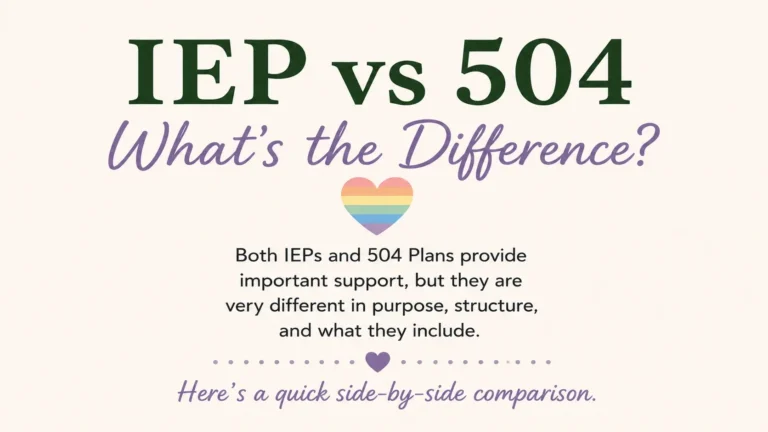
The difference between the two comes down to the legal framework and the kind of plan the child needs. A 504 falls under civil rights law and may include accommodations, special education, and related aids or services needed for equal access and a free appropriate public education. An IEP falls under IDEA, special education law, and requires an eligible disability category, but in exchange it comes with specially designed instruction, measurable annual goals that get tracked and reported on, and related services like counseling, occupational therapy, or speech built directly into the plan. Both plans are legally enforceable. An IEP follows IDEA’s detailed requirements for specially designed instruction, annual goals, services, and procedural safeguards. If your child’s 504 keeps feeling like it’s missing something, that gap is worth examining closely and discussing with the school team.
How the 504 Process Works in New York City
The qualification process starts with identifying a physical or mental impairment that substantially limits a major life activity, learning, concentrating, reading, communicating, and so on. Schools must identify and evaluate students believed to have a disability, at no cost to the parent. Here in New York City, the DOE evaluates 504 eligibility through a school-based 504 Team, made up of a 504 Coordinator, relevant teachers, and sometimes a nurse or counselor if the disability is health related, along with you. A request can come from a parent or from school staff. The team’s review may include school records, teacher observations, medical information, outside evaluations, and information from the parent. New York City Public Schools states that no 504 plan may be implemented without written parental consent, which is typically given when the plan is completed or soon afterward. Documentation such as medical records, outside evaluations, teacher observations, is what turns the meeting from a conversation into an actual plan, though signing it is far from the finish line.
Getting the plan written is only the beginning. Read it carefully, more than once, and don’t assume everyone implementing it has read it as closely as you have. Keep your own log, separate from the school’s records, of what’s actually working and what isn’t, specific dates, specific classes, specific accommodations that got skipped. That log is your data, and it’s often more honest and more detailed than anything the school is tracking. Do your own research on what similar kids’ plans include, and build a real relationship with your school’s 504 liaison, not just as a contact for problems, but as someone you check in with regularly. Needs shift as a child gets older or as a school year changes shape, so the plan has to be revisited and updated, not filed away and forgotten the day it’s signed, and that ongoing attention is what exposes a well-meaning idea that doesn’t always hold up.
Self-Advocacy Cannot Be the Backup Plan
Here’s something that still doesn’t sit right with me. Schools often say the goal is teaching your child to self-advocate, to speak up and ask for their own accommodations in the moment. For a lot of kids, that’s a reasonable goal. But for a child whose anxiety is the exact reason they need the accommodation in the first place, that expectation can fall apart completely. Ask a child to raise their hand and request extra time on a test while they’re already choked up, throat tight, mind racing, and you’re asking them to perform the one skill their anxiety has just taken offline. Self-advocacy is a wonderful long-term goal to build toward, gradually, with support. It cannot be the backup plan for the exact moment a child is least able to use their own voice, which is exactly why it’s on you to hold that ground until they’re ready to hold it themselves.
Common Questions About 504 Plans
Can a child move from a 504 plan to an IEP?
Yes. If a 504 plan isn’t meeting your child’s needs, you can request an evaluation for special education under IDEA in writing at any time.
Is a 504 plan legally binding?
Yes. Section 504 is a federal civil rights law, and a school that receives federal funding must implement the plan.
You Are Not Asking for a Favor
Knowing this history and this process changes how you walk into that meeting. You’re not asking for a favor, and you’re not asking for something optional. You are invoking a federal civil rights law that exists because people fought hard to make it enforceable, and you get to use every bit of that leverage on your child’s behalf.
If your child’s 504 looks complete on paper but the real record tells a different story, RDT can help you organize the plan, evaluations, school communications, and implementation concerns before your next meeting.
Raising Different Together ❤️
Has a 504 worked for your child, or did you end up needing to push further toward an IEP? Comment ❤️ below, your experience might be exactly what another parent needs to read.
Official sources and further reading
Federal guidance and local procedures can differ. These official resources provide more detail on the processes discussed above.
You don’t have to do this alone.
Feeling buried in paperwork? We help parents organize the record, understand what’s actually in front of them, and prepare for the next conversation, so you walk in focused instead of overwhelmed.
You’re not doing this alone.