
IEP vs. 504: What’s the Difference?
IEPs and 504 plans get talked about as if they are the same thing with different names. They are not. They come from different federal laws, use different eligibility rules, and offer different kinds of support.
The shortest useful answer is this: an IEP is generally for a student who, because of a qualifying disability, needs specially designed instruction. A 504 plan is generally for a student whose disability substantially limits a major life activity and who needs accommodations, aids, services, or other support to access school.
That is a helpful starting point, not a legal eligibility test. The right path depends on an individual evaluation and what the child actually needs.
What Is an IEP? It Can Change How Your Child Is Taught
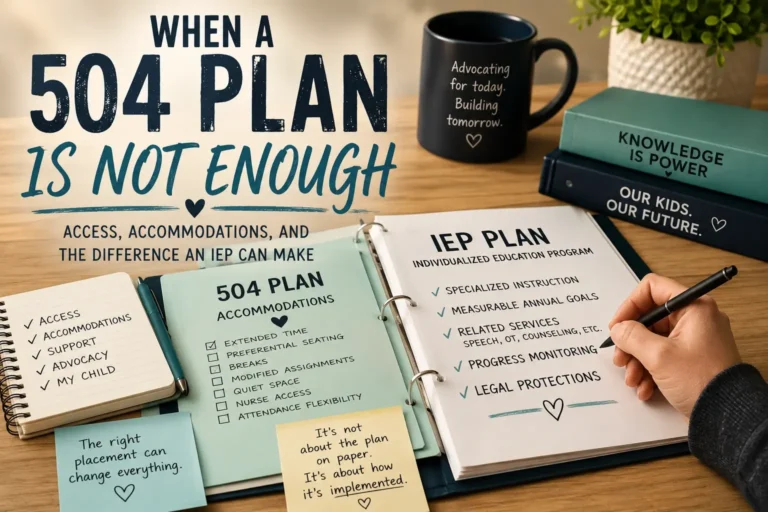
An IEP (Individualized Education Program) comes from the Individuals with Disabilities Education Act (IDEA), the federal special education law. It can provide specially designed instruction, related services such as speech, occupational therapy, or counseling, measurable annual goals, progress reporting, accommodations, and procedural protections.
Under the federal IDEA eligibility definition, two things generally must both be true: the child is evaluated as having a disability recognized under IDEA, and because of that disability, the child needs special education and related services.
An IEP is individualized. The question is not simply whether a diagnosis exists. The team must look at how the disability affects the child’s education and what instruction, services, goals, and supports are needed.
What Is a 504 Plan? It Is About Access, and Can Include More Than Accommodations
A 504 plan comes from Section 504 of the Rehabilitation Act of 1973, a federal civil rights law. Many 504 plans focus on accommodations such as extended time, a quieter testing space, breaks, noise-reducing headphones, preferential seating, or help with medical needs during the school day.
But a 504 plan is not limited to a list of accommodations. The Section 504 education regulations describe regular or special education and related aids and services designed to meet a qualified student’s individual educational needs as adequately as the needs of nondisabled students are met.
Section 504 eligibility is generally broader than IDEA eligibility. A student may qualify when a physical or mental impairment substantially limits one or more major life activities, such as learning, concentrating, reading, communicating, walking, seeing, hearing, or caring for oneself.
IEP vs. 504 plan at a glance
| IEP | 504 plan | |
|---|---|---|
| Federal law | IDEA | Section 504 of the Rehabilitation Act |
| Central eligibility question | Does the child have an IDEA-recognized disability and, because of it, need special education? | Does the student have an impairment that substantially limits a major life activity and need support for equal access? |
| May include | Specially designed instruction, related services, goals, accommodations, and progress monitoring | Accommodations, regular or special education, and related aids or services |
| Goals and progress | Measurable annual goals and progress reporting are required | Does not use IDEA’s same required annual-goal and progress-reporting framework |
| Typical plan | A detailed, formal Individualized Education Program | A written access plan whose format can vary by school or district |
The one-line version, and its limit
A 504 plan often changes the conditions around the child. An IEP can change the instruction itself.
That shorthand is useful, but it is not the whole law. A 504 plan can include aids and services, not only accommodations. An IEP can include accommodations as well as specialized instruction. One plan is not automatically “better” than the other; the question is which protections and services fit the student’s evaluated needs.
And being bright does not disqualify a child. Federal IDEA regulations say FAPE must remain available to an eligible child who needs special education even if that child is passing and advancing from grade to grade. Our family learned firsthand that a child can be gifted and struggling at the same time.
How the IEP and 504 Processes Differ
An IEP denial does not automatically result in a 504 plan. If you want the school to consider Section 504 eligibility, put that request in writing too. At the same time, schools have their own responsibilities to identify and notify families about qualified students under Section 504.
A 504 plan is not a “lite IEP,” and it is not a required first step before requesting an IDEA evaluation. If you believe your child may need specially designed instruction, you can request a full special education evaluation directly.
If your child’s evaluations, school records, and current plan are becoming impossible to sort through, we can help you organize the documents and prepare clear questions for your next school meeting.
Common questions about IEPs and 504 plans
Is an IEP stronger than a 504 plan?
They provide different protections. An IEP usually has a more detailed required structure for instruction, services, goals, progress reporting, and parent participation. Section 504 provides important civil rights protections and can require accommodations, aids, and services. The better fit depends on the child, not on which document sounds stronger.
Can a child be protected by both IDEA and Section 504?
Yes. A student with an IEP is also protected from disability discrimination under Section 504. Schools commonly document the child’s accommodations and services within the IEP rather than maintaining a separate 504 plan, but families can ask the team how every need will be documented and implemented.
Does a child have to fail before qualifying?
No. Passing grades, promotion to the next grade, or a high test score does not automatically rule out disability or eligibility. The team should consider the whole child, including effort, independence, progress, functional needs, and the support required to succeed.
What should I do if I am not sure which plan my child needs?
Start by writing down your concerns and asking for an appropriate evaluation. Include specific examples of what you are seeing at school and at home. Keep a dated copy of your request and begin organizing evaluations, report cards, progress information, and school communications. Our parent’s guide to beginning special education advocacy can help you take that first step.
How do I request a 504 plan?
Put your request in writing to your child’s school, usually the principal or the school’s 504 coordinator. Describe what you are seeing, how it affects your child at school, and attach any diagnosis or evaluation you have. Keep a dated copy.
Who creates the IEP in New York City?
For most NYC public school students, the IEP is developed by an IEP team at the child’s school. Students attending private, religious, or charter schools are usually served through the district’s Committee on Special Education (CSE).
Choosing the Right Next Step for Your Child
You do not need to diagnose the plan before asking for help. You need a clear record of the concerns, an evaluation that looks at the relevant areas, and a team willing to discuss what support the child needs. And once a plan exists, the work changes shape. A signed plan is not a delivered plan. Here is what to do if the school is not following it.
Keep Reading: IEPs, 504s and Your Rights
- What Is FAPE? The One Word That Decides Almost Every IEP Fight
- When a 504 Plan Is Not Enough
- School Not Following the IEP? What Parents Can Do Next
- Finding the Right School Placement for Your Child
- Gifted and Struggling: When a Bright Child Still Needs an IEP
You don’t have to do this alone.
Feeling buried in paperwork? We help parents organize the record, understand what’s actually in front of them, and prepare for the next conversation, so you walk in focused instead of overwhelmed.
Raising Different Together provides parent-to-parent educational information, document organization, and advocacy preparation. We are not attorneys and do not provide legal advice or representation. Requirements and procedures may vary by state and individual circumstances.
Primary sources: IDEA §300.8, IDEA §300.101, 34 CFR §104.33, and 34 CFR §104.32. Reviewed July 2026.
You’re not doing this alone.