
Start Here: How Special Education Actually Works (From a Parent Who Had to Figure It Out)
If you are reading this, something probably brought you here. Maybe a teacher said the word “evaluation.” Maybe a report card stopped adding up. Maybe you have known in your gut for a long time that your child is working twice as hard for half the result, and someone finally said out loud what you had been afraid to ask.
Wherever you are, take a breath. This guide exists to give you the map I did not have.
The special education process usually moves through the same basic stages: a concern is identified, a referral or evaluation request is made, the parent gives consent, evaluations are completed, a team decides eligibility, and the school either develops a plan or explains its decision in writing. After that, the plan must be implemented, monitored, and reviewed.
You do not have to understand every acronym today. You just have to find your starting place.
The Two Federal Laws Behind Most School Support
Two federal laws come up again and again when families ask for school support: IDEA, which governs special education and IEPs, and Section 504, a civil rights law that protects students with disabilities from discrimination.
- IDEA is the law behind the IEP, or Individualized Education Program. An IEP can include specially designed instruction, related services, measurable goals, progress reporting, accommodations, and procedural protections.
- Section 504 is a civil rights law. A 504 plan commonly documents the accommodations, aids, services, or other support a qualified student needs to access school without disability discrimination.
The shorthand I use is: a 504 plan often changes the conditions around the child; an IEP includes specially designed instruction. That is a useful starting point, not a legal eligibility test. A 504 plan can include aids and services, and an IEP can include accommodations too. Our plain-language guide to the differences between an IEP and a 504 plan explains the details.
How the IDEA and IEP Process Generally Works
The steps below describe the IDEA and IEP process, with New York-specific notes where they matter. Section 504 uses a different legal framework and local procedures, so do not assume every IDEA timeline below applies to a 504 plan.
1. A concern becomes a written referral or request
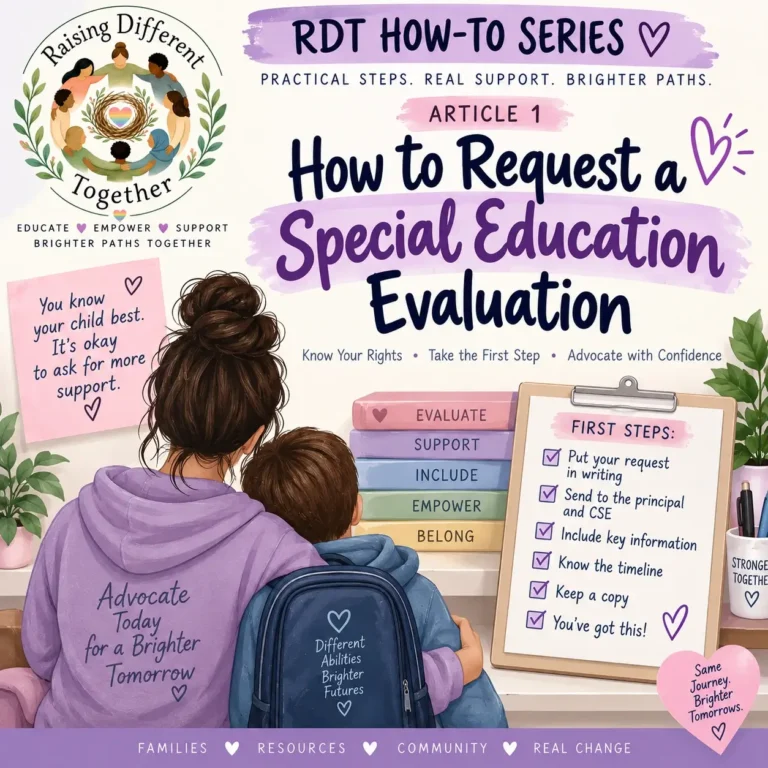
Put the concern in writing. Describe what you are seeing, include specific examples, and ask for an evaluation when you believe a disability may be affecting your child’s education. In New York, a parent’s formal referral is made in writing.
A written referral creates a dated record and starts the referral process. It does not, by itself, start the federal 60-day evaluation period. That evaluation timeline begins after the school receives written parental consent to evaluate.
Parents can request an evaluation, and schools also have a responsibility under IDEA’s Child Find requirements to identify, locate, and evaluate children who may have disabilities and need special education.
2. The school asks for consent and completes the evaluation
Before an initial special education evaluation, the school generally must provide information about the proposed evaluation and obtain informed parental consent.
Under the federal IDEA evaluation timeline, the initial evaluation generally must be completed within 60 days after parental consent, unless the state has established a different timeframe or a limited exception applies.
New York note: New York State generally requires the initial evaluation to be completed within 60 calendar days after the school receives parental consent, subject to limited exceptions. The official New York special education procedures explain the state-specific process.
The evaluation should be broad enough to answer the real questions. Federal rules require assessment in all areas related to the suspected disability, not only the easiest or most obvious concern. Depending on the child, that may include academics, communication, attention, executive functioning, social-emotional needs, behavior, sensory or motor needs, hearing, vision, health, or other areas.
3. A team reviews the information and decides eligibility
The team reviews the evaluations, school data, teacher information, parent input, and the child’s individual needs. In New York, this group is called the Committee on Special Education (CSE) for a school-age child and the Committee on Preschool Special Education (CPSE) for a preschooler. Other states and districts may simply call it the IEP team.
You are a member of that team, not a guest. You can ask questions, share outside evaluations and records, explain what you see outside school, and ask how the data supports the proposed decision.
4. The school develops a plan or explains its decision
If the child is found eligible under IDEA, the team develops an IEP describing the child’s needs, goals, services, accommodations, placement, and how progress will be measured and reported.
If the school proposes or refuses to begin or change the child’s identification, evaluation, educational placement, or provision of FAPE, IDEA requires Prior Written Notice a reasonable time before the action or refusal. The notice must describe the action, explain why, identify the evaluations or records relied upon, describe other options considered and rejected, and note other relevant factors. A PWN is not simply a denial letter and a bare “no” is not enough.
A verbal “no” should not be the end of the record. Ask for the decision and reasoning in writing. If your child is not found eligible for an IEP, the team may still need to consider Section 504 or other appropriate general education supports, depending on the child’s needs.
5. The plan is implemented, monitored, and reviewed
An IEP is not finished when everyone signs or leaves the meeting. Services and accommodations must be implemented, progress must be measured, and the team should review the plan when the information shows it is not working as expected.
This is where understanding FAPE and meaningful progress becomes important. A polished document matters less than whether the plan is reasonably designed for this child and whether the team responds thoughtfully to the progress information.
If you are not sure the services are actually happening, here is how to check whether the IEP is being followed, what to document, and what to ask for.
A Few Truths It Took Me Years to Learn
- Bright does not mean fine. A child can be gifted and disabled at the same time. People often call that twice-exceptional, or 2e. Our son’s 99th-percentile score existed alongside a very real reading struggle.
- Passing does not automatically mean a child does not need support. IDEA requires individualized decisions, including for eligible children who are advancing from grade to grade.
- Kindness is not a plan. A caring teacher’s informal help can be wonderful, but important supports should not disappear when the teacher or classroom changes.
- Get it in writing. Follow verbal conversations with a calm email confirming what you understood, what was agreed upon, and what happens next.
- The whole pattern matters. Look at the gaps between ability and output, school and home, strong scores and weak scores, or what a child can do once and what they can do independently and consistently. Those gaps may be important information.
Where Should You Start?
- If you are brand new: read IEP vs. 504 Plan: What’s the Difference? and A Parent’s Recipe for Special Education Advocacy.
- If you’re ready to ask for an evaluation: read How to Request a Special Education Evaluation.
- If the plan looks fine but progress is missing: read What Is FAPE? and gather the progress information connected to the current goals.
- If your bright child is struggling in ways people keep missing: read our stories about a gifted child struggling in kindergarten and what “high-functioning” autism can actually look like.
- If the paperwork has become too much to hold in your head: see how RDT organizes records and prepares parent questions.
Common Questions
Do I need a medical diagnosis before requesting a school evaluation?
No. A parent can request a school evaluation when there is reason to suspect a disability may be affecting the child’s education. An outside diagnosis can provide useful information, but the school must use its evaluation process to make educational eligibility decisions.
Does sending an evaluation request start the 60-day clock?
Not by itself. The federal 60-day evaluation period generally begins when the school receives parental consent to evaluate, unless the state uses a different timeline. A written request is still important because it creates a dated record and begins the referral process.
What if the school says my child is doing fine?
Ask what information supports that conclusion. Look beyond overall grades to progress, independence, effort, goal data, interventions, functional needs, and the amount of adult help required. “Fine” should lead to a discussion of evidence, not end the conversation.
If pulling all of that evidence together is the part that feels overwhelming, we can help you organize the record, spot the patterns, and prepare the questions you want to bring back to the school.
Raising Different Together ❤
You don’t have to do this alone.
Feeling buried in paperwork? We help parents organize the record, understand what’s actually in front of them, and prepare for the next conversation, so you walk in focused instead of overwhelmed.
Keep Reading: The Special Education Process
- Recipe to Special Education Advocacy: First Steps After a Diagnosis
- How to Request a Special Education Evaluation for Your Child
- The Wait That Shouldn’t Exist: Evaluation Wait Times
- How to Prepare for Your Child’s IEP Meeting
- Corner Talk: IEP Meeting Advocacy Tips
- How to Navigate a CSE Meeting
Raising Different Together provides parent-to-parent educational information, document organization, and advocacy preparation. We are not attorneys and do not provide legal advice or representation. Requirements, timelines, terminology, and procedures can vary by state and individual circumstances. For advice about your child’s specific rights or a filing deadline, consult a qualified special education attorney or local Parent Training and Information Center.
Primary sources: IDEA §300.101, IDEA §300.111, IDEA §300.301, IDEA §300.304, IDEA §300.503, Section 504 §104.33, and New York State §200.4. Reviewed July 2026.
You’re not doing this alone.