Child OCD Diagnosis: When Anxiety Stacks on ADHD and Everything Gets Harder
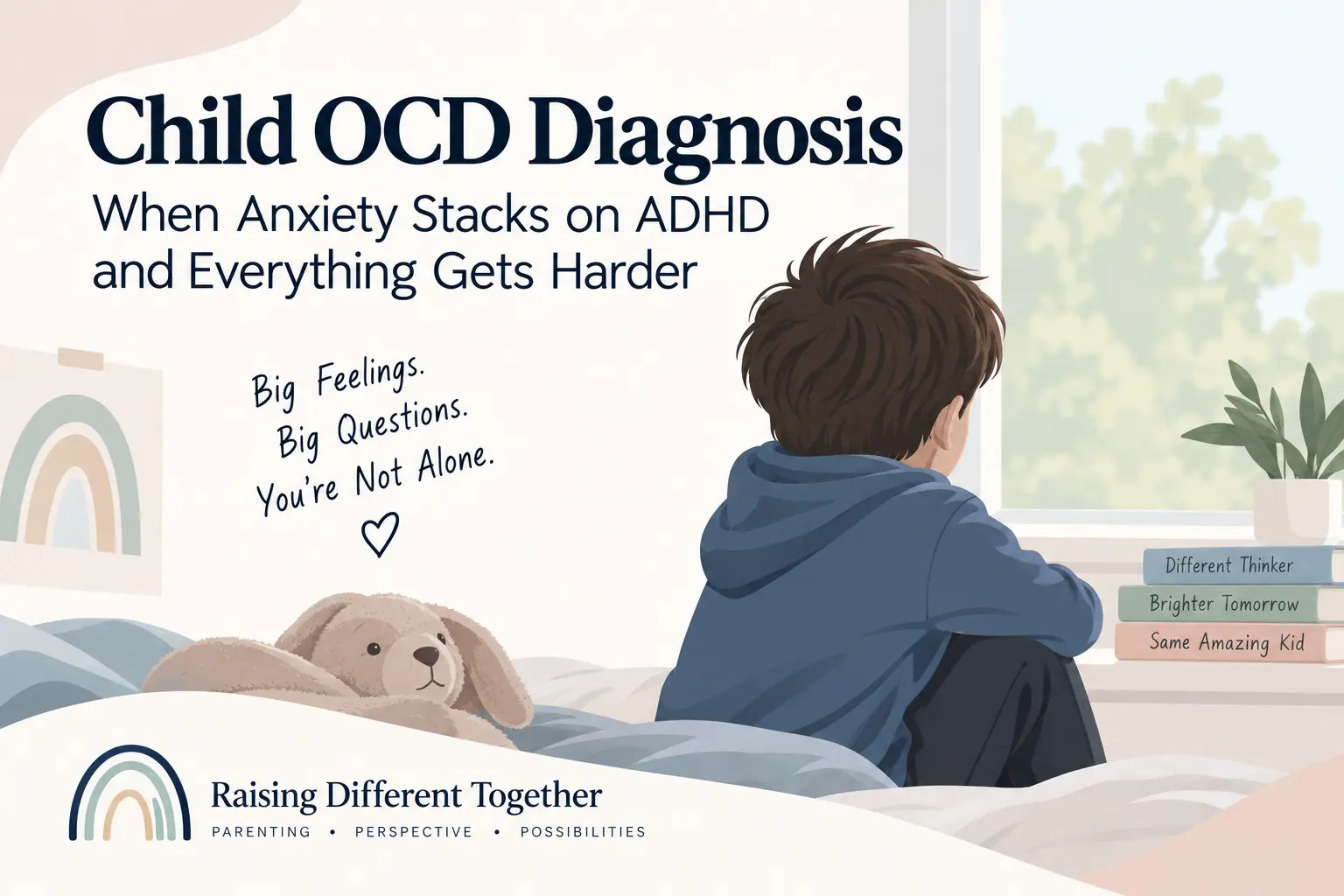
Last week, Caydence was officially diagnosed with OCD. Not as a correction to something we thought was happening. Not as a clarification of anxiety we already knew existed. But as an addition, stacked on top of ADHD combined type, generalized anxiety disorder, and school-based anxiety that we’ve been managing for years. I want to say I was shocked, but the truth is I’ve watched this particular anxiety pattern unfold in her for some time. I’ve recognized the compulsions: the need for things to be a certain way, the pull toward even numbers, the checking that never quite satisfies. I’ve noticed the way her ADHD brain clashes with her OCD brain: her ADHD says nope, let’s be spontaneous and chaotic, while her OCD says no, we need order, we need it perfect, we need it safe. They fight each other constantly, and Caydence is caught in the middle, exhausted by the internal war. I’ve known something was there. And now it has a name, a clinical framework, and a medical diagnosis that somehow makes it both more real and more manageable at the exact same time.
The short answer: OCD can appear alongside ADHD and anxiety in children. In girls it often looks like perfectionism, a need for things to be “just right,” reassurance-seeking, or fear of germs. ADHD and OCD can pull in opposite directions, one toward spontaneity and the other toward order. Exposure and response prevention (ERP), a type of CBT, is the standard therapy for childhood OCD.
What OCD Can Look Like in a Child With ADHD
The doctor’s description stuck with me because of its perfect, terrible accuracy: OCD is anxiety but on steroids. Not just worry. Not just intrusive thoughts. This is the anxiety that spirals, that loops, that creates a narrative in her brain and then demands proof that the narrative isn’t true, and then demands more proof, and then demands it again. For Caydence, it shows up as the need for things to be just right: even numbers, specific arrangements, a particular way of doing things. It shows up in test anxiety that doesn’t come from us, from school, or from any external pressure, but from inside her own mind demanding perfection in her grades. It shows up as sensitivity to loud noise that actually manifests as headaches, her body’s way of shutting down when the sensory input becomes too much. And it showed up in germ anxiety so intense that she was afraid to touch things, afraid to throw away trash, caught in a loop of avoidance that just made the fear bigger. I’m reading research papers at midnight learning what OCD in girls actually looks like, because it presents differently than the stereotypes. I’m learning CBT frameworks, exposure and response prevention, understanding how tools and techniques for child anxiety actually work in real time. And I’m learning that Caydence’s experience is valid, and common, and worth understanding deeply.
When OCD and ADHD Pull in Opposite Directions
What I know is that Caydence needs to hear this first: there is nothing wrong with her. Her brain works differently. The way she processes anxiety, the loops her thoughts get caught in, the way her body responds to fear, that’s not a character flaw. That’s not weakness. That’s just how her neurology is wired, and there is nothing shameful or broken about it. Everything else flows from that. Because once she believes that about herself, that she’s not defective, that her OCD doesn’t make her less-than, we can actually build tools. Techniques for child anxiety that work for her specifically: grounding techniques that use sensory input to snap her back into her body, breathing that she can access in the moment, movement that helps shake out the paralysis. Sometimes it’s ice water on her wrists. Sometimes it’s a strong smell that cuts through the fog. Sometimes it’s sour candy that jolts her nervous system back online. Sometimes it’s just shaking her whole body out and naming what she’s feeling out loud. What works shifts, and that’s okay. But underneath all of it is this: you are not broken, you are not alone, and you are capable of moving through this.
How OCD Showed Up as Contamination Anxiety
The proof is in what’s already happening. Caydence was terrified of germs. The contamination fear was so big that she wouldn’t touch the trash, wouldn’t risk getting dirty, was caught in a cycle of avoidance and reassurance-seeking that just fed the anxiety. But we started using CBT mindset techniques: exposure and response prevention, positive self-talk, gradually facing the fear instead of running from it. And now? She’s throwing out the garbage. It sounds small until you understand that for her, that’s a massive act of courage. That’s her brain learning that the feared thing isn’t as dangerous as it feels. That’s her nervous system recalibrating. That’s proof that she can work through this, that the tools work, that the anxiety doesn’t have to call all the shots anymore.
Learning About ERP and CBT for Childhood OCD
The research mountain is enormous. The learning curve is steep. Understanding ADHD in girls is one thing; understanding how ADHD in girls with OCD works together is another entirely. They create friction and chaos inside her mind. There’s medication to consider, therapy modalities to navigate, the eternal question of what to adjust and what to try and what to wait on. There’s the particular exhaustion of explaining a new diagnosis to school, of updating IEP accommodations to include OCD-specific support, of watching teachers nod and understand and still sometimes missing the way her anxiety manifests in ways that don’t fit the typical picture. There’s the specific guilt of knowing this was there all along and wondering if I could have gotten her help sooner. But there’s also this: Caydence now has a framework for understanding what’s been happening. We now have language. We now have CBT tools, grounding techniques, and a map for how to move through this. It’s not everything. But it’s something. And something is what we’re building from.
Supporting a Child With OCD, ADHD, and Anxiety
So to every parent raising a girl with ADHD and OCD, or noticing their child’s need for things to be “just right,” or watching their kid’s anxiety manifest as perfectionism, sensory sensitivity, or compulsions, I want you to know: it’s okay that you didn’t know everything already. It’s okay that you’re learning this in real time. It’s okay that some days you feel like you’re drowning in research and acronyms and trying to be a therapist and a teacher and a support system all at once. Your child doesn’t need you to be an expert. She needs you to be present, to learn alongside her, to help her understand her own body and mind, and to believe in her capacity to work through this. And somehow, in the middle of the exhaustion and the research and the new diagnoses, that’s exactly what you’re doing.
Common Questions
Can OCD be included in a child’s IEP or 504 plan?
Yes. If OCD affects learning or access to school, accommodations such as extra time, breaks, or a plan for when compulsions interfere can be added.
This article shares one family’s experience and general educational information, not medical advice. OCD, ADHD, and anxiety require individualized evaluation and treatment by qualified healthcare professionals. Do not start, stop, or change medication without consulting your child’s clinician.
The Conversation Continues
If your child has been diagnosed with OCD, or if you’re navigating the particular exhaustion of stacking diagnoses, we want to hear from you. The weight of learning a new anxiety landscape is real, and you don’t have to do it alone.
Share your story in the comments or connect with us at hello@raisingdifferenttogether.com.
Caydence is still learning. We’re still learning. And we’re doing it together.
Have a story of your own? ❤
Every family’s journey looks different, whether you’re a parent, grandparent, aunt, uncle, or caregiver walking alongside a child with special needs. If you’d like to share your story with our community, we’d be honored to feature it. Reach out at hello@raisingdifferenttogether.com.
And if you’re in the thick of it right now, here’s how we help families like yours.
You’re not doing this alone.