The Marriage Question: What the Research Actually Says About Special Needs Families
You’ve probably heard the statistic. Eighty percent of marriages raising a child with autism end in divorce. It gets repeated at conferences, in support groups, in well-meaning articles trying to underscore how hard this journey is. Here’s the truth: there is no credible study behind that number. The largest study ever conducted on this question, tracking nearly 78,000 families, including 913 with a child on the spectrum, found that parents of children with autism split up at essentially the same rate as everyone else.
That doesn’t mean this journey is easy on a marriage. It means the myth we’ve been telling each other isn’t the full story, and the real story is more complicated, and honestly, more useful to understand.
What the Research Actually Shows
The real research does show elevated risk, just not the catastrophic kind. One national survey found a 28% divorce rate among families of children with autism compared to 20% for other families. A 28-year longitudinal study following children from diagnosis into adulthood found that about 36% experienced their parents’ divorce by the time they turned 30, with two clear danger zones, the early years right after diagnosis, and again during the teenage years.
Higher divorce rates in that study were also linked to lower maternal education, families with fewer financial resources, and more severe symptom presentations, which tells us this isn’t really about autism itself. It’s about stress, support, and resources, or the lack of them.
That stress is not abstract. Caregivers of children with complex medical needs face a four-fold increase in risk for PTSD compared to the general population. Studies on parents of children with severe chronic conditions have found PTSD rates hovering between 15 and 20%, and the research is consistent on what drives it: low social support, relentless caregiving demands, and a parent’s own unresolved mental health history.
That is not a personality flaw or a sign of weakness. That is what chronic, high-stakes stress does to a nervous system that never gets to fully stand down, not during a hospitalization, not during an IEP fight, not during a two AM meltdown.
What Almost Broke Our Marriage
I’ve lived a version of this that almost didn’t survive, and I want to be honest about what actually almost broke it, because it wasn’t what people usually assume. There was a point where Charles and I came close to splitting, and it was never because I didn’t love him. I was, and still am, madly, deeply in love with my husband. What pushed us to the edge was frustration, and underneath that frustration, pure instinct to protect our children.
We had genuinely different parenting methods, shaped by different cultures and different upbringings, and those differences collided hard in real time, in the middle of meltdowns, in the middle of transitions, in moments where consistency mattered most. I made it clear to him that I wasn’t threatening to leave over something small. I was doing it because I wasn’t willing to fight for two steps of progress only to watch it get knocked back five steps by a different approach in the very next moment.
Learning to Parent as a Team
The saving grace was that Charles chose to close that gap instead of defending his side of it. He started actually learning each of our children’s diagnoses, not surface level, but really learning them. He watched how I handled meltdowns and started mirroring it. He learned to give the same transition warnings I’d been giving, in the same way, so our kids weren’t getting two different sets of rules from two different parents. He kept learning until we were fully on the same page, united and consistent, and our children thrived even more because of it.
It also meant he stopped leaving the entire weight of it on me by default, which changed our marriage as much as it changed our parenting. And it went both ways. I made my own effort to be more patient with him while he was catching up, and to actually share what I knew instead of expecting him to just absorb it, because closing that gap was never going to be his job alone.
Three neurodivergent children means our energy is tapped dry some days, there’s no version of this that isn’t exhausting. But we are a team now in a way we weren’t always, and we worked hard to heal that gap rather than let it split us. That work is exactly why I can say what I said above and mean every word of it, we came out of that season stronger as a family, not despite the conflict, but because we were both willing to work through it instead of around it.
What Helps Us Stay Connected
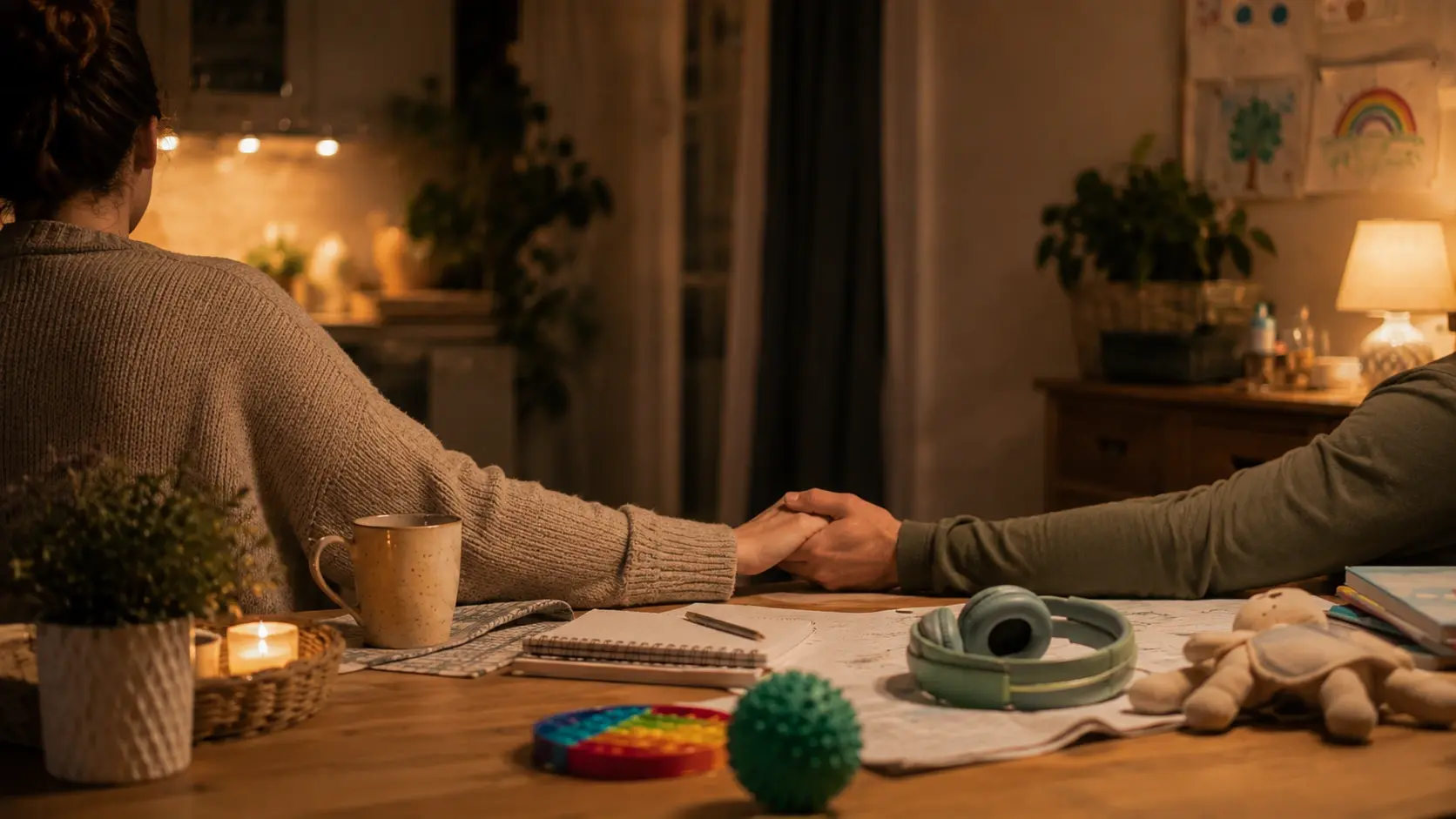
What has actually helped us since then is small and unglamorous. We protect tiny windows of connection wherever we can find them, a car ride, a late night after the kids are finally down, instead of waiting for a big date night that may not come for months.
We say thank you out loud, often, for the load one of us is carrying that week, because resentment grows fastest in silence. We’ve also had to get honest about needing outside support, whether that’s couples counseling, individual therapy, or just another parent who understandswithout needing the whole backstory explained.
When a Marriage Doesn’t Survive
And if a marriage doesn’t survive this, that is not a verdict on either parent’s love for their child. Co-parenting well after separation means staying aligned on medical decisions, IEP goals, and routines, even when the marriage itself didn’t make it, because your child’s stability was never actually dependent on your relationship status, it’s dependent on both of you staying present and consistent. Whether you’re fighting to keep a marriage standing or learning to co-parent from two households, the goal is the same one it’s always been: a child who knows, without question, that both parents are still fully in this fight for them.
Raising Different Together ❤️
Have a story of your own? ❤
Every family’s journey looks different, whether you’re a parent, grandparent, aunt, uncle, or caregiver walking alongside a child with special needs. If you’d like to share your story with our community, we’d be honored to feature it. Reach out at hello@raisingdifferenttogether.com.
And if you’re in the thick of it right now, here’s how we help families like yours.
You’re not doing this alone.