Moving Their Minds: How Sports and Movement Help Neurodivergent Kids Thrive
Movement has done more for our kids than almost any therapy we’ve paid for, and I say that as someone who has paid for a lot of therapy. There’s something that happens in a neurodivergent body when it gets to move with purpose, whether that’s across a dance floor, a volleyball court, down a lap lane, or over a horse’s stride, that regulates something no amount of sitting still ever could. Occupational therapists call part of this a sensory diet, deliberately built-in movement and sensory input throughout the day that helps a nervous system stay regulated instead of swinging between overwhelmed and shut down.
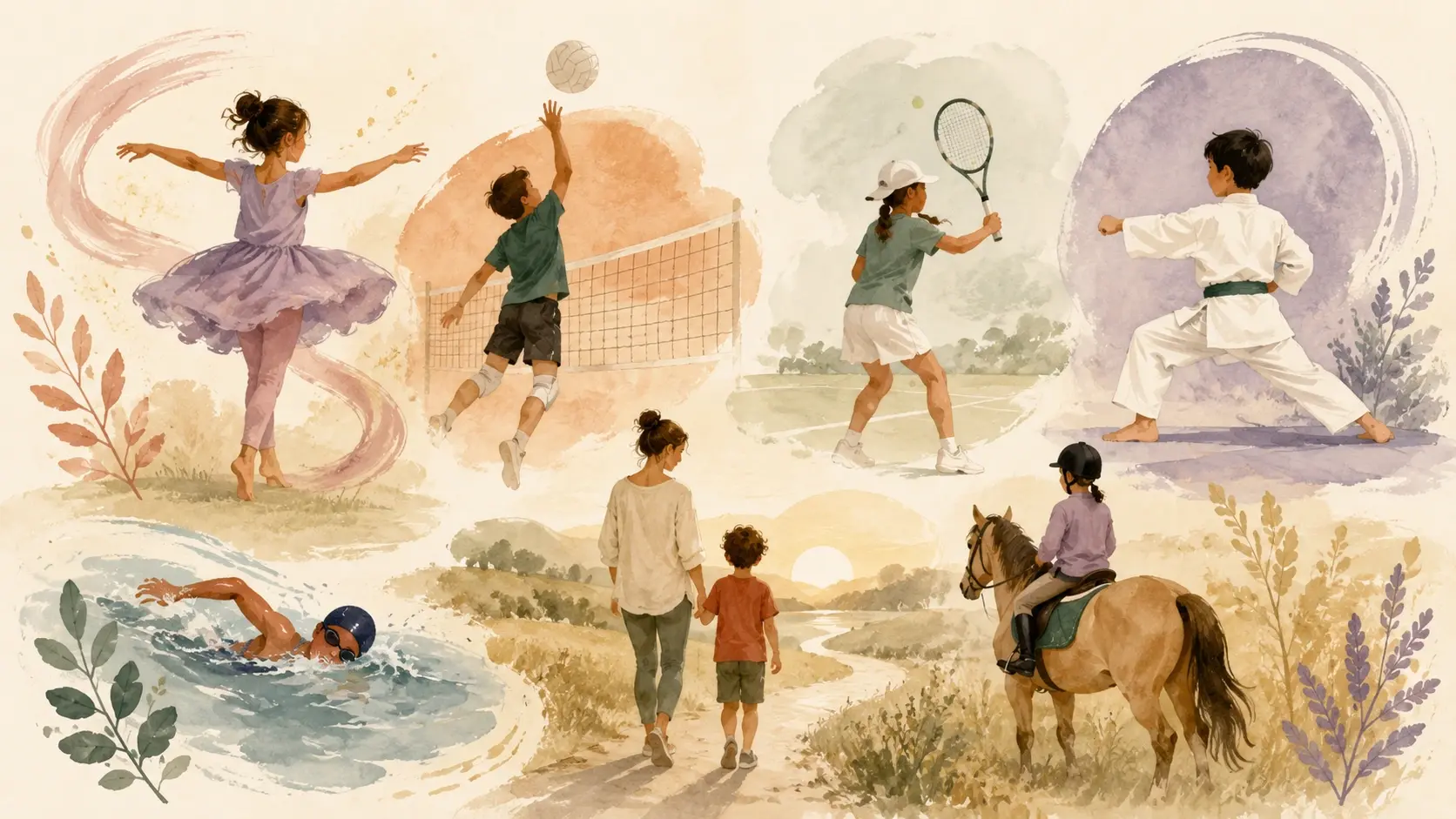
For our family, that sensory diet hasn’t lived in a clinic. It’s lived on a dance floor, a volleyball court, a tennis court, a mat, and the back of a horse, and Charles has been right there for nearly every practice, every match, every drop-off and pickup, just as invested in finding what works for each of our kids as I am.
Finding the Right Movement for Each Child
Dance and Volleyball
Caydence found her regulation through dance, and more recently through volleyball too. Competition dance asks a body to memorize sequences, hit counts precisely, and perform under real pressure, and somewhere in doing all of that, she found a place where her focus and her body worked together instead of against each other. Volleyball added a different kind of demand entirely, fast reaction time, constant communication with teammates, and the kind of split-second trust that only comes from playing alongside the same people over and over.
Between the two, she’s gotten routine in the truest sense, structured practices and rehearsals week after week, which is its own kind of regulation for a mind that does better with predictability. She’s also gotten two different kinds of team. Dance is often thought of as an individual sport, but a competition team lives and dies by trust and timing, and volleyball takes that even further, since one missed read on the court affects everyone on it. Charles is usually the one keeping track of her game schedule and cheering loudest from the sideline, and that visible investment from her dad matters to her as much as the sport itself does.
Tennis and Tae Kwon Do
Carlos found his outlets in tennis and Tae Kwon Do, two sports that could not look more different but that both demand the same core skills, coordination, focus, and the ability to read a moment and respond to it in real time. Tennis asks him to track a ball, anticipate an opponent, and adjust instantly, which builds concentration in a way that’s active instead of forced. Tae Kwon Do added structure and discipline, with the belt system giving him a visible, achievable ladder of progress, along with a physical outlet for energy and frustration that might otherwise have nowhere to go. Both sports gave him something else too, a legitimate arena where his effort and his growth were plainly visible to him, not filtered through a diagnosis or a comparison to anyone else.
Horseback Riding
Coah found his calm on the back of a horse. Equine therapy and horseback riding ask for a kind of quiet, attuned communication that doesn’t rely on words at all, which matters enormously for a kid who sometimes struggles to find the right words under pressure. There is real research behind this too, therapeutic riding has been shown to support attention, emotional regulation, and social communication in autistic children, likely because the rhythmic movement of the horse provides steady, predictable sensory input while the relationship with the animal demands patience and gentleness in return. For Coah, that partnership with an animal that
responds honestly to his energy has taught him something about self-regulation that no verbal
conversation ever fully landed.
Why Swimming Can Be So Regulating
All three of them have swum at some point, and swimming might be the great equalizer of the group. Water provides full-body sensory input, pressure, temperature, resistance, that can be deeply calming for an overwhelmed nervous system, while still demanding coordination and focus to move through it. It’s one of the few activities that’s simultaneously intense exercise and genuinely soothing, which is a rare combination for kids whose bodies are often either understimulated or overstimulated with very little in between.
Movement Does Not Have to Be Organized
And then there’s the movement that doesn’t come with a uniform or a schedule at all, workout regimens at home, a walk around the park, just moving a body that needed to move. These count just as much as the structured sports. Regular movement supports emotional regulation, gives an outlet for anxiety and excess energy, and builds body awareness that helps with coordination in everyday life, not just on a field or a court. Sometimes the most therapeutic thing we do all week is simply walk, no goals, no scoring, just moving side by side.
What Movement Builds Beyond Physical Skills
Across every single one of these activities, the benefits stack on top of each other. Teamwork. Socialization. Routine. Coordination. Concentration. Collaboration. And maybe most importantly, a physical, embodied way to navigate emotions that words don’t always reach. Movement has taught our kids things about regulation, connection, and confidence that Charles and I could never have taught them from a worksheet or a therapy chair alone.
Raising Different Together ❤️
Have a story of your own? ❤
Every family’s journey looks different, whether you’re a parent, grandparent, aunt, uncle, or caregiver walking alongside a child with special needs. If you’d like to share your story with our community, we’d be honored to feature it. Reach out at hello@raisingdifferenttogether.com.
And if you’re in the thick of it right now, here’s how we help families like yours.
What sport or movement has been a game changer for your kid? Comment ❤️ below, we’re always looking for the next thing to try.
You’re not doing this alone.