Sleep Disruption When Routines Change: Anxiety, ADHD Clocks, and Survival Mode
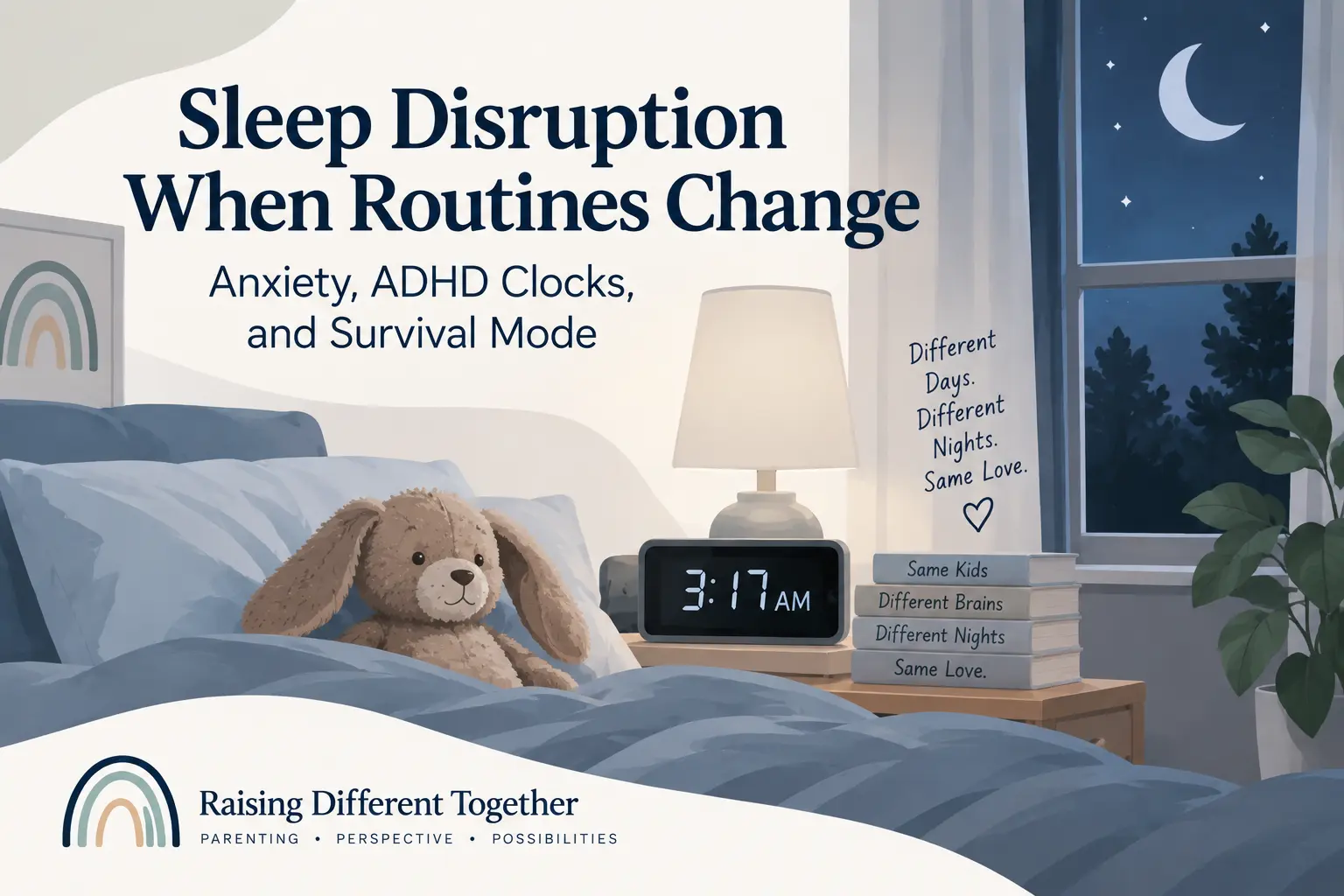
Sleep is the first thing to go. Not because my kids don’t want to sleep. They want to sleep. We all want to sleep. But anxiety doesn’t knock before it walks in at bedtime. It brings intrusive thoughts. It brings the racing mind that won’t turn off. It brings the fear of the unknown: what if something bad happens? What if I can’t fall asleep? What if, what if, what if? And the restlessness that comes with it, the feeling of electricity under their skin, the inability to settle no matter how tired they are. Bedtime should be the easiest transition of the day. Instead, it’s where everything falls apart. Because transitions like summer to school, school to vacation, or the predictable chaos of a long weekend followed by back-to-school trigger the kind of anxiety that doesn’t care how exhausted the body truly is. The mind is running a marathon while the body is begging to rest.
The short answer: Kids with ADHD and anxiety often struggle with sleep, especially during routine changes like the start of school. Racing thoughts, restlessness, and body clocks that run differently all play a part. What usually helps is a mix of a predictable bedtime routine, physical activity before bed, calming sound, and working with your child’s doctor on any medical supports.
Why ADHD and Anxiety Can Make Sleep Harder
And here’s the thing that makes it exponentially harder: all three of my kids have ADHD, and they each have their own internal sleep clock. Not one of them operates on the same schedule. Carlos’s body wants to go to bed late and wake late. Caydence’s system is somewhere in the middle but inconsistent. Coah’s clock shifts depending on the day, the anxiety level, the sensory input. Three different neurological rhythms under one roof, all trying to sleep at the same time because school starts at a certain hour and the world doesn’t adjust for ADHD brains. It’s chaos. It’s maddening. And it’s the reality of parenting neurodivergent kids where the outside world’s schedule collides with their internal biology.
What Sleep Problems Look Like in Our House
The impact of disrupted sleep ripples through everything. No sleep means dysregulation. No sleep means crankiness that lasts all day. No sleep means a kid who can’t regulate their emotions, can’t focus at school, can’t manage their anxiety or their ASD and ADHD symptoms. And that affects not just the kid who didn’t sleep, but everyone in the household. If Coah didn’t sleep, he’s moody, can be aggressive and refusal-based all day. If Caydence’s anxiety kept her up, she’s emotionally fragile and overwhelmed by everything. If Carlos is running on no sleep, his college stress compounds because his brain can’t function on fumes. And me? I’m managing all of that while running on my own sleep deficit, trying to hold everyone together, trying to figure out how to fix something that feels unfixable.
How Routine Changes Disrupt Sleep
There are specific triggers tangled up in all of this. For Coah and Carlos, it’s the night leg braces meant to help their muscle tone. They’re uncomfortable. They trigger sensory discomfort. They become a barrier to sleep every single night. They fight them. Their bodies rebel. Sleep doesn’t come easy when you’re physically uncomfortable and triggered. For all of them, it’s the anxiety that comes with transitions: new school, new routine, new uncertainty. The change itself is the stressor, and their nervous systems stay in overdrive even when their heads hit the pillow. And then there are the schedule shifts: summer sleep (late nights, sleeping in) to back-to-school sleep (early mornings, rigid bedtime). Their bodies haven’t caught up to the new schedule. The anxiety is trying to protect them from the unknown of the new routine. And the ADHD brain doesn’t follow the typical circadian rhythm anyway. With older kids, it’s less about negotiating bedtime and more about the genuine hardship of getting their minds to calm down enough for sleep to be possible. That’s the real battle.
What We’ve Tried to Help Our Kids Sleep
We’ve tried everything under the sun. Doctors, therapies, medication, routines, research, oils, teas. Some things work. Some things don’t. And what works for one child doesn’t work for the others. So, we’ve built individual regimens. Zoloft for all three because the anxiety that keeps their minds racing is real and chemical and needs to be managed before sleep is even possible. Melatonin to help Coah actually fall asleep, though keeping him asleep? That’s a different battle entirely. We’ve added physical work: pushing against the walls to expend that restless energy, rolling around on the exercise ball to give their bodies something to do while their minds settle. White noise or calming music to give the racing thoughts something to compete with, something consistent and predictable. Timers and visuals so they know what’s coming. Reading as ritual. We’ve adjusted, tweaked, removed, added back. We learn what works this month and what stops working next month. There’s no magic bullet. There’s just trial and error and the willingness to keep trying.
Charles is a huge part of the nighttime routine. He’s there managing one kid while I manage another. He’s doing the physical work. The wall pushes, the exercise ball rolling, the calming presence that helps settle their nervous systems. He’s helping set up for success the next day, because sleep is about so much more than just closing your eyes. It’s about managing the anxiety, creating the conditions for calm, being a team. Yes, he’s tired. Yes, he’s working and carrying the financial weight and showing up at night even though his body is screaming for rest. But he’s also part of the solution, not just a casualty of the problem. And I’m learning that I can’t do this alone, and it’s not supposed to be done alone. This is a team sport, and we’re playing it together.
But this is also what we’re doing. We’re showing up. We’re trying. We’re learning what works for each of our kids and implementing it even when we’re running on hope and a prayer. We’re adjusting when school transitions flip everything on its head. We’re getting up in the morning and doing it again even though nobody slept well. We’re medication-compliant because the Zoloft matters, the melatonin matters, the structure matters, even when it’s not perfect. We’re not giving up on sleep, even though sleep is giving up on us most nights. We’re in survival mode, and that’s what survival mode looks like: showing up exhausted, doing the best we can with what we have, and accepting that some nights will be better than others.
Letting Go of the Guilt Around Sleep
I learned grace the hard way. At first, there was guilt. Guilt that I couldn’t fix it faster. Guilt that some nights didn’t go smoothly. Guilt about falling asleep in the chair while trying to put them to bed because I was so exhausted. But then something shifted. I stopped asking “why can’t I do this perfectly” and started asking “what’s the problem tonight and how do we work through it.” Some nights the problem is anxiety spiking. Some nights it’s the leg braces being particularly uncomfortable. Some nights it’s a schedule change that threw everyone off. Some nights it’s just that their bodies need to move before they can rest. Once I stopped drowning in the guilt and started problem-solving, sleep became less of a battle and more of a puzzle we’re solving together. Whoa. Breathe. I got this. It’s okay. Find the problem. Work through it. That’s the grace I’ve learned.
This article shares one family’s experience and general educational information, not medical advice. Sleep problems, ADHD, and anxiety require individualized evaluation and treatment by qualified healthcare professionals. Do not start, stop, or change any medication or supplement, including melatonin, without consulting your child’s clinician.
The Conversation Continues
If sleep disruption has taken over your household, if your kids’ different internal clocks are creating chaos, if you’re running on hope and fumes and trying everything you can think of. We see you. And you’re not alone in this.
Share your sleep survival stories in the comments or connect with us at hello@raisingdifferenttogether.com.
Sleep will come. Eventually. For all of you.
Have a story of your own? ❤
Every family’s journey looks different, whether you’re a parent, grandparent, aunt, uncle, or caregiver walking alongside a child with special needs. If you’d like to share your story with our community, we’d be honored to feature it. Reach out at hello@raisingdifferenttogether.com.
And if you’re in the thick of it right now, here’s how we help families like yours.
You’re not doing this alone.